
The National Genotyping Programme (NGP) is widely recognised for accelerating genetic gain and improving breeding decisions. However, one of its lesser-known benefits is its ability to identify animals carrying lethal genetic mutations, helping farmers avoid high-risk matings and costly fertility losses.
Benefits of the National Genotyping Programme for Farmers
The NGP provides farmers with more accurate breeding information, helping identify the best replacement animals and supporting better breeding decisions. It also improves traceability by verifying parentage, breed composition and animal identity, while identifying recording errors that might otherwise go unnoticed. These benefits contribute to improved fertility, greater herd efficiency and increased profitability.
How NGP Identifies Hidden Genetic Risks
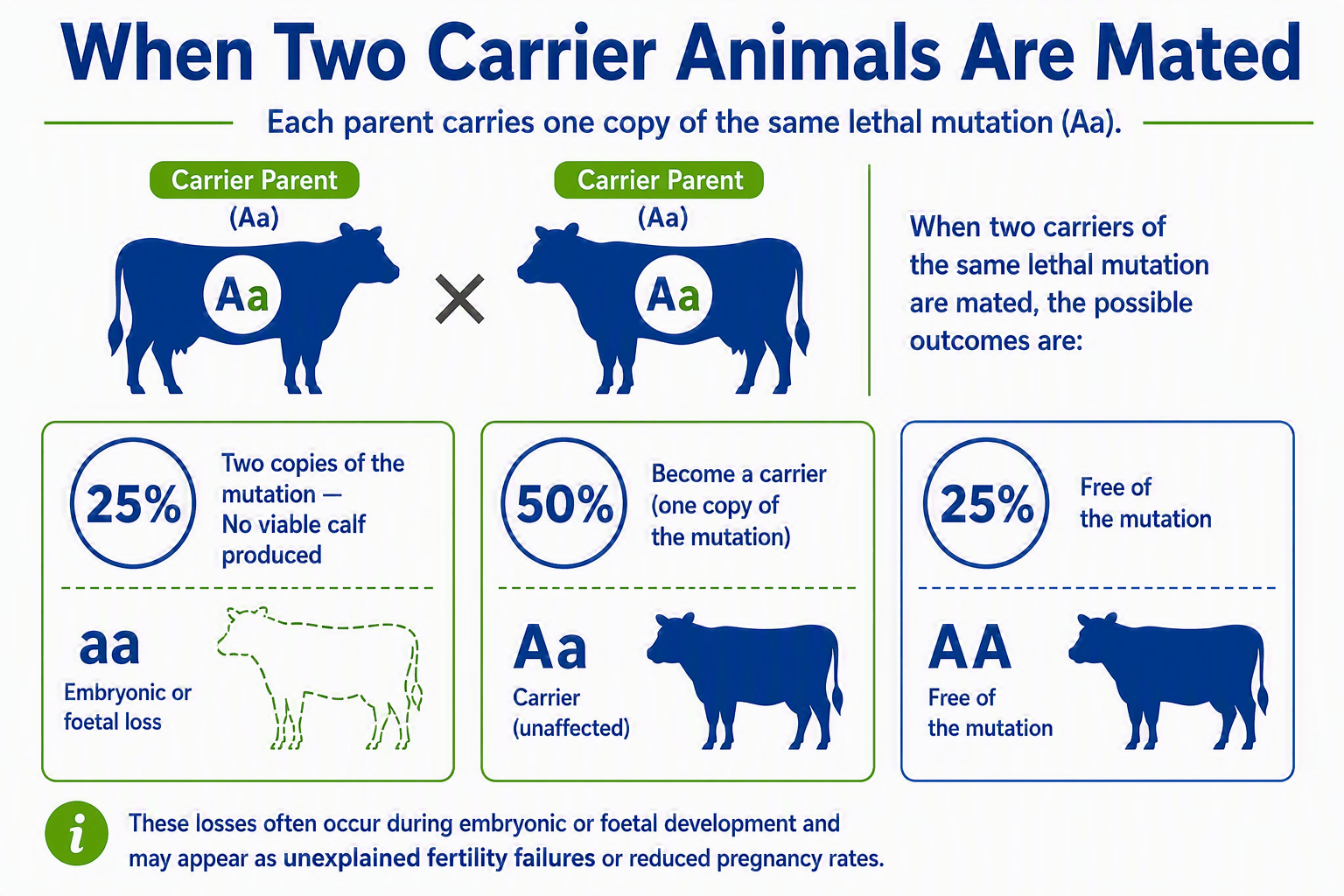
One practical application of NGP data is the identification of lethal recessive mutations. Like humans, cattle can carry harmful genetic mutations without showing any signs themselves. Problems only arise when an animal inherits two copies of the faulty gene.
When two carrier animals are mated, there is:
- A 25% chance the offspring will inherit two copies of the mutation and fail to survive
- A 50% chance the offspring will become a carrier
- A 25% chance the offspring will be free of the mutation
These losses often occur during embryonic development and may appear as unexplained fertility failures.
HH1 and HH3: Common Holstein Genetic Mutations
Two of the most common lethal recessive mutations found in Holstein-Friesian cattle are:
- HH1 (Holstein Haplotype 1)
- HH3 (Holstein Haplotype 3)
Approximately 2% of Irish Holstein-Friesians carry the HH1 mutation, while around 5% carry HH3. While carrier animals are healthy and productive, mating two carriers significantly increases the risk of pregnancy loss and reduced herd fertility.
Based on these prevalence rates, several thousand carrier-to-carrier matings are expected to occur annually within the Irish dairy herd.
Fertility Impact on Dairy Herds
The HH1 mutation is particularly significant because pregnancy loss can occur up to 200 days into gestation. In seasonal calving systems, this can leave farmers with cows that were assumed to be in calf but are later found empty at the end of the breeding season.
The result can be:
- Reduced six-week calving rates
- Fewer replacement heifers
- Increased replacement costs
- Reduced herd efficiency
NGP Data Integrated into ICBF Sire Advice
To help avoid these losses, genotype information generated through NGP has been incorporated into the ICBF Sire Advice system.
The system, which already helps farmers avoid inbreeding, now identifies and avoids carrier-to-carrier matings involving lethal mutations such as HH1 and HH3. As new mutations are discovered, the system can be updated to ensure farmers continue to benefit from the latest genomic information.
An Estimated €2.2 Million Annual Benefit
With a 5% prevalence of HH3, approximately 2.5% of dairy matings involve two carrier animals. Assuming one million dairy cows receive an average of 1.5 dairy services annually, this equates to approximately 3,750 HH3 carrier-to-carrier matings. Adding an estimated 600 HH1 carrier matings brings the total number of high-risk matings to around 4,350 each year.
Based on a replacement heifer value of approximately €1,000 above cull cow value, the cost associated with these failed pregnancies is estimated at €2.2 million annually for the Irish dairy sector.
Delivering More Value from NGP
The identification of lethal recessive mutations such as HH1 and HH3 demonstrates how NGP data can be used to solve practical on-farm challenges. By integrating genomic information into tools such as ICBF Sire Advice, farmers can avoid high-risk matings, improve herd fertility and reduce avoidable losses. This is another example of how NGP is turning genomic information into practical, on-farm benefits for Irish dairy farmers.