
Balancing full-time construction work with farming, James Reilly, Ballyjamesduff, Co Cavan, runs a highly efficient beef finishing system built on strong grassland management, simple feeding and tight 12-month finishing. His results show how consistency, herd health and smart use of Commercial Beef Value drive performance and profitability.
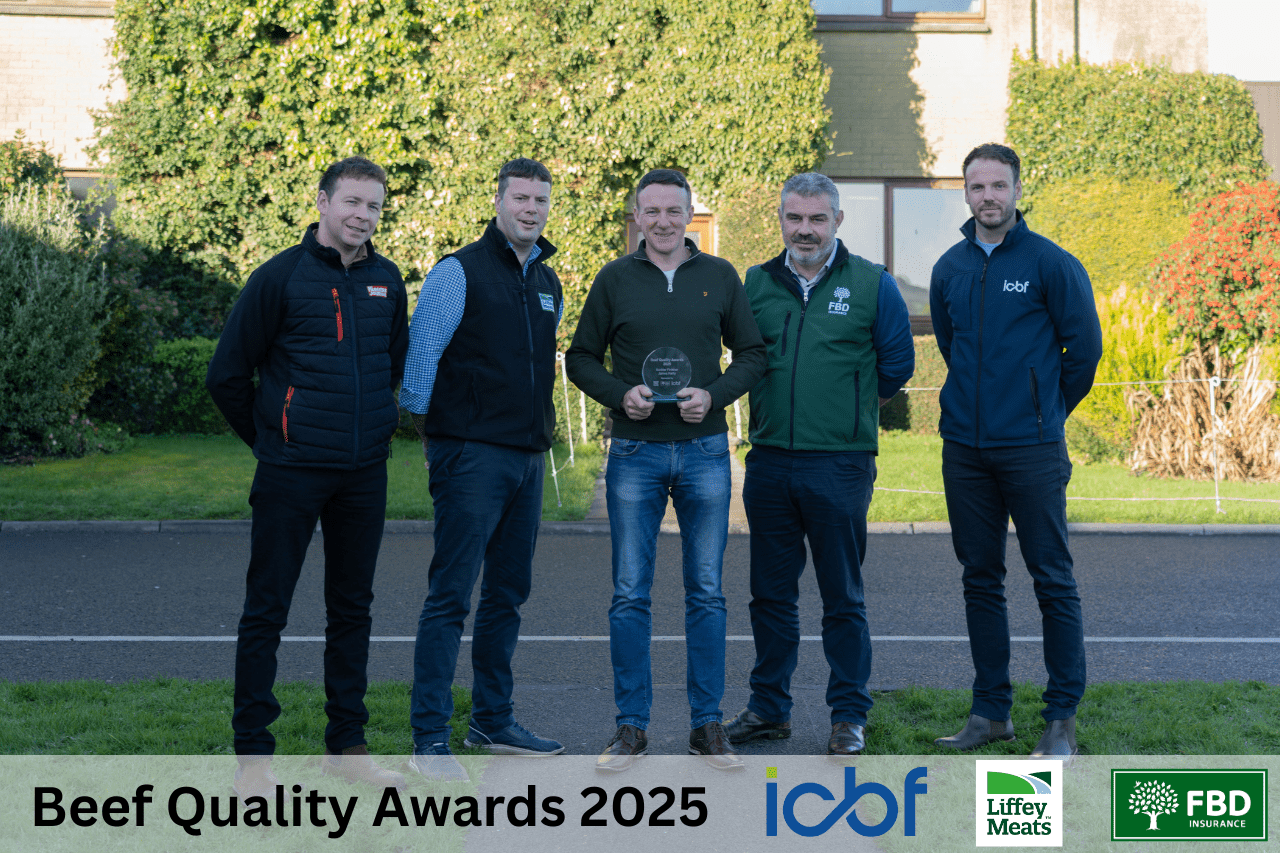
L to R – Nevan McKiernan, Sean O’Beirne (Liffey Meats), James Reilly (Award Winner), Conor McGovern (FBD), Conor Brown, (ICBF)
A full‑time building career combined with a growing beef and sheep enterprise, James Reilly from Ballyjamesduff, Co Cavan has developed a cattle‑finishing system that emphasises efficiency, routine and performance. Farming 140 acres, he grazes up to 120 continental‑cross heifers throughout the summer and finishes around 100 annually, supported by a flock of Suffolk and Texel‑cross ewes. His system is built on doing the basics well: maintaining good grass quality, keeping feeding simple, prioritising herd health and focusing on a tight 12‑month finishing period that suits both his land and work commitments.
James’ year begins with early turnout, often from late February into early March when ground conditions allow, enabling heifers to achieve maximum growth from grass. Around a quarter to a third of the heifers finish directly off grass in late autumn, with the remainder moving indoors for final finishing. Once housed, James maintains a straightforward feeding regime using high‑quality end‑of‑May bale silage complemented by a nut‑based ration. This approach ensures consistency while also keeping the system labour‑efficient. As he explains, keeping things simple is essential when balancing farm work with full‑time employment.
Cattle are sourced year‑round through local marts, where James looks for good‑quality, U‑grade Charolais‑type heifers weighing between 380 kg and 420 kg. The animals must have the potential to finish within 12 months, ensuring the system remains predictable and financially viable. He sells finished cattle primarily to Liffey Meats. In addition to factory sales, James sells 15–20 suitable heifers each year for breeding, moving them either privately off‑farm to repeat customers or through local mart sales.
Animal health is central to maintaining performance. All incoming cattle are vaccinated for pneumonia and wormed upon arrival, with follow‑up dosing during summer and again in winter. Regular silage sampling ensures that winter feeding remains balanced and that no nutritional shortfalls hinder performance. James places particular emphasis on avoiding any setbacks that disrupt growth, reiterating that “If they get a blip at all, they’ll not leave money.” This attention to health and consistency plays a key role in supporting the performance differences documented through his Commercial Beef Value data.
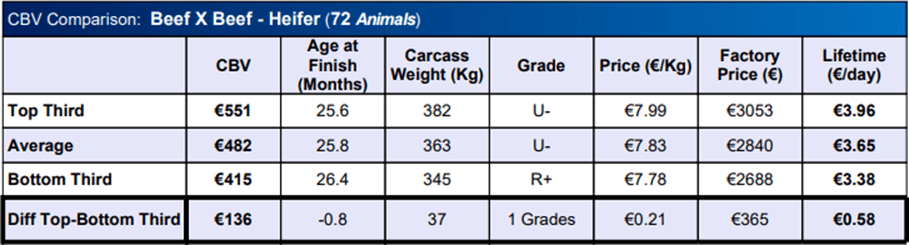
James’ Annual Finishing Report highlighted a substantial gap in performance between higher‑ and lower‑CBV heifers. Out of 83 heifers finished, 72 carried a CBV. The top third, averaging a CBV of €551, finished almost a month earlier, produced carcasses 37 kg heavier, graded a full grade higher, returned €365 more per head and delivered €0.58 additional revenue per day over their lifetime. In contrast, the bottom third, averaging a CBV of €415, finished later, produced lighter carcasses, achieved lower grades and generated reduced profitability. These results validated James’ existing selection criteria, revealing that the traits he naturally targeted at purchase were the same ones highlighted by the CBV index.
The Commercial Beef Value aligns closely with what drives success in James’ system. It focuses on carcass weight, carcass conformation, feed intake, age at finish, factory in‑spec and docility, traits that strongly influence finishing speed, cost of production and finishing performance. For a finishing system based on early grass utilisation and simple winter feeding, CBV provides a dependable indicator of an animal’s ability to finish efficiently. Higher‑CBV animals, by design, tend to finish younger, consume less feed, and yield better carcasses, making them ideal for James’ system.
Looking ahead, James intends to continue developing the cattle enterprise. Sheep numbers have decreased in recent years, and he hopes to expand cattle numbers further as the system is easier to manage alongside his construction work. While he continues to sell a small selection of breeding‑quality heifers to regular customers, finishing remains the centre of the business. His farm offers a clear example of how strong grassland management, straightforward feeding practices, attention to herd health and the use of Commercial Beef Value combine to produce a high‑performing, profitable finishing system. The CBV has shown itself to be more than a genetic figure—it is a practical decision‑making tool that strengthens purchasing decisions and reinforces the performance outcomes James achieves year after year.
ICBF would like to congratulate James on achieving the 2025 Suckler Finisher Award for Liffey Meats.
For more information on the Commercial Beef Value (CBV), click here