
Irish‑bred genetics leading the national dairy herd
AI bulls play a vital role in developing the national herd, and it’s worth noting that the top 75 bulls on the Active Bull List are now Irish-bred. This puts the responsibility on Irish farmers to breed the next generation of top-performing bulls. While getting a bull into AI is challenging, it is certainly possible, and the benefits make it worthwhile.
Located in Rathcormac, North Cork, Thomas, Kathy and John Kearney farm in partnership, milking 213 pedigree registered cows under the herd prefix “Browney.” The herd has contributed significantly to the national breeding programme. They operate a spring-calving system with a strong focus on genetics and excellent grassland management to maximise milk solids production. The Browney herd has an EBI of €182, placing it in the top 5% of herds nationally. The herd also has a Milk Sub‑Index of €39 and a Fertility Sub‑Index of €78. The Kearneys have made strong progress in improving herd EBI, achieving an average annual rate of gain of €13.2. This progress is evident in their Dairy Trend Report, where genetic indexes are based on the number of dairy cows in the herd on 30th June each year and are calculated using the November 2025 evaluation.
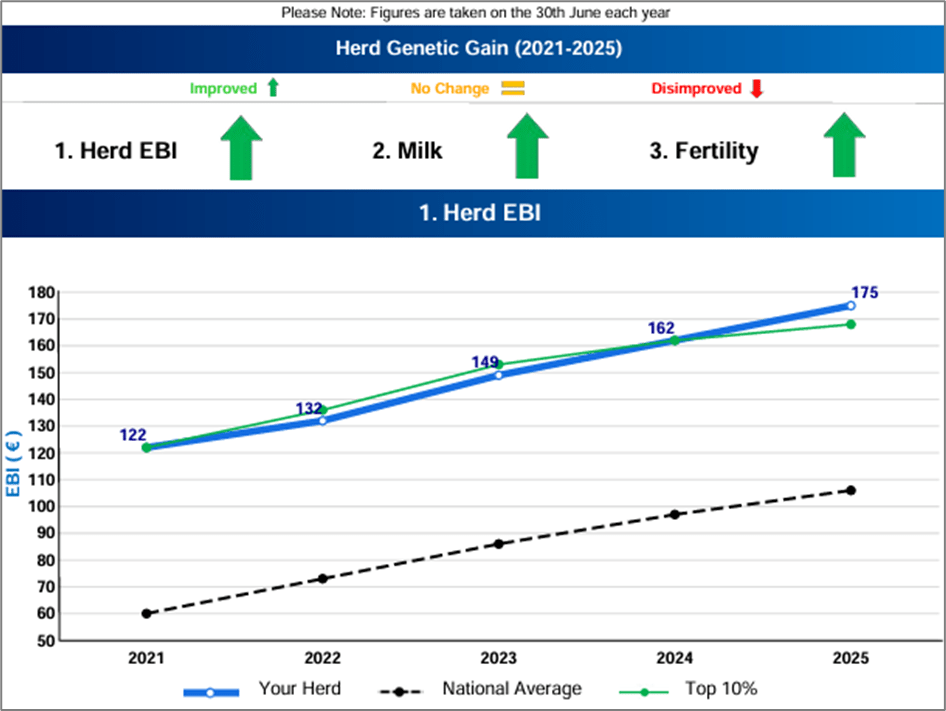
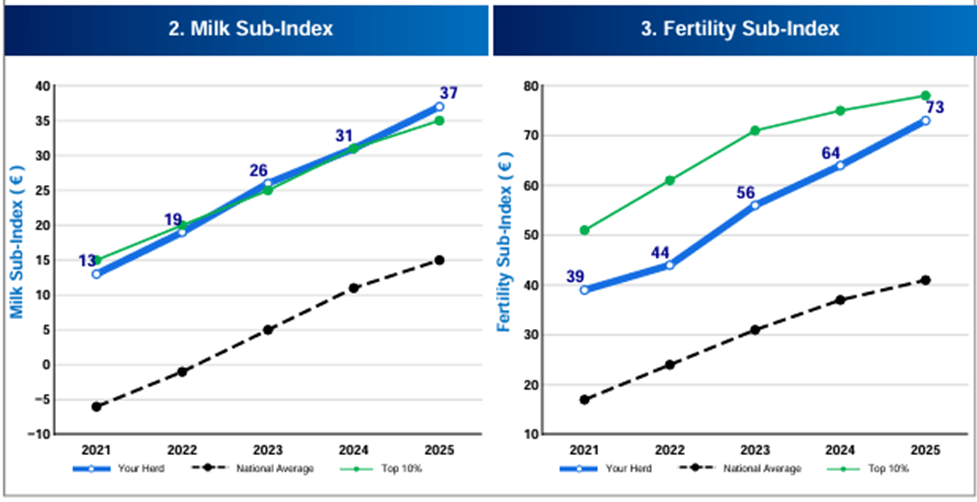
Relating the herd’s genetic gain trends to on‑farm performance, milk solids per cow have increased significantly, rising from 480 kg per cow in 2021 to 543 kg per cow in 2025. By utilising the Economic Breeding Index (EBI), the herd has also achieved an impressive 89% six‑week spring calving rate. While the Kearneys acknowledge that these improvements are not solely due to genetics, with management and environmental factors also playing important roles, genetics remains the primary driver of the farm’s continued strong performance. The herd’s key performance indicators are presented in the table below.
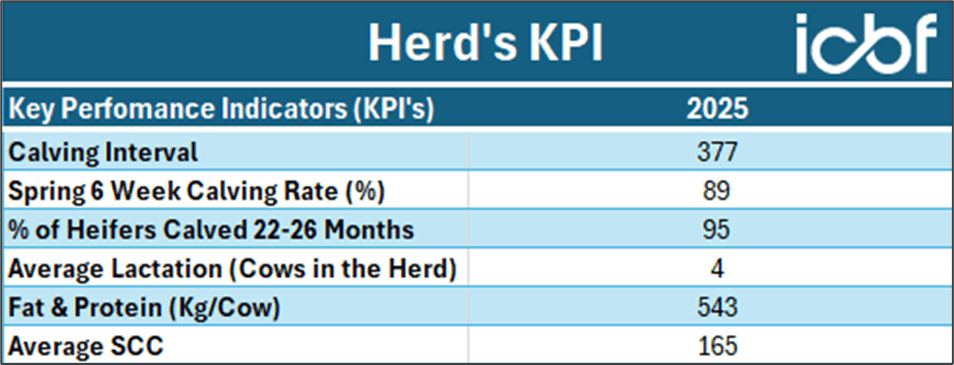
When it comes to breeding, the Kearneys use a large team of high EBI genomic sires and consistently use the Sire Advice application to select bulls that align with the herd’s breeding goals. These bulls are then matched to the cows to maximise EBI, while reducing the variation between milk and fertility and avoiding inbreeding. Breeding commenced on 15 April last year, with excellent submission rates achieved, as 85% of cows and 94% of heifers were submitted within the first three weeks of the breeding season. A similar mating start date is planned for this year. In relation to milk recording, the herd is milk recorded every five to six weeks (10–11 recordings per year). This allows the Kearneys to closely monitor cow performance, identify underperforming cows for culling, and pinpoint top-producing cows best suited to breeding replacement heifers.
National Genotyping Programme
The herd has been genotyping all their heifer calves for a number of years and joined the National Genotyping Programme(NGP) when it launched in 2023. It has been a key driver of the herd’s genetic progress. Genotyping calves at birth has allowed the Kearneys to make more informed and confident decisions at a much earlier stage when selecting the next generation of replacement animals. Genomic evaluations offer substantially higher reliability than parent-average evaluations, with an increase of approximately 25–30%. This adds a large amount of valuable information to each animal’s indexes and has helped to fast‑track genetic improvement within the herd, particularly for low‑heritability traits such as fertility. In addition, genotyping has identified any parentage errors and has confirmed the exact sire and dam of all calves at birth as part of the NGP.
The Kearneys went on to say, “Confirming parentage through genotyping is particularly useful when a large number of calves are being born over short periods of time, where it can be difficult to figure out the correct sire and dam of the animal. It gives us absolute clarity on the parentage of the animal.”
The Kearneys also highlighted “ The best way to profit from genotyping is to make use of the genomic information that you get back, be it helping to decide what animals to keep or sell if you have surplus heifers. It has helped immensely with our breeding decisions”
Breeding Future AI Bulls
The outstanding genetic merit of the Browney herd has been recognised as a valuable source of genetics for the Dairy Gene Ireland breeding programme, with bulls entering AI companies and achieving widespread use over many years. To date, the herd has had 11 bulls progeny tested through Dovea Genetics, Eurogene AI and NCBC. Some of the most recent bulls bred by the Kearneys that are currently on the Active Bull List include FR9007 (Browney Evanet), FR9118 (Browney Crystal SRM), and FR1353 (Browney Denzel SRM). The herd has consistently supplied high-genetic-merit bulls to Irish dairy farmers, with one of the most popular being FR6481 (Browney Barna SRM), which had 6,612 calving records in the March 2026 evaluation. More recently, FR2519 (Browney Roger) with an EBI of €294 was selected for testing through the Dairy Gene Ireland programme, with the first crop of his progeny arriving on dairy farms this Spring.
The Kearneys continue to use the highest EBI sires available each year. They participate annually in the Dairy Gene Ireland breeding programme, selecting the Holstein Friesian breed pack. In addition, they work annually with each AI company on contract matings to breed potential AI sires. As part of this process, some of the herd’s best cows are deliberately bred to nominated elite bulls using conventional semen, with the objective of producing the next generation of high EBI sires for dairy farmers to choose from each year. A strong supply of high-EBI AI bulls plays a vital role in driving ongoing genetic advancement in Irish dairy herds.
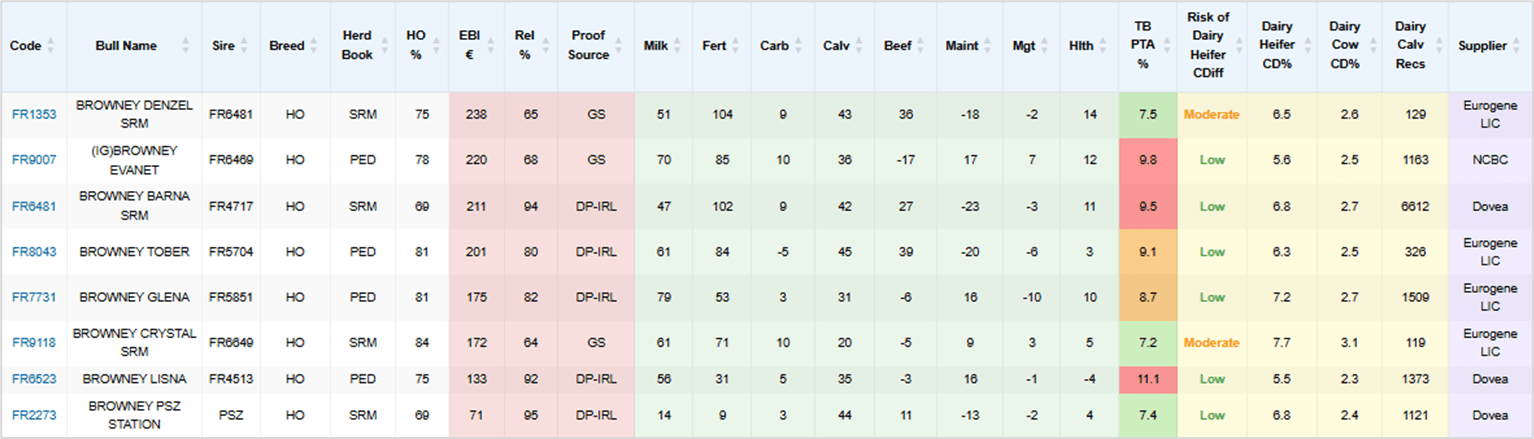
The number of AI bulls bred from the herd is a testament to their strong focus on continually improving the genetic potential of the herd, alongside fully utilizing the various HerdPlus reports, profiles and applications to support informed breeding decisions. Furthermore, participation in the National Genotyping Programme and the use of the Sire Advice programme have played pivotal roles in achieving optimal matings, contributing significantly to the breeding success of the herd. This approach will continue to support increased genetic gain into the future. The Kearney family also wishes to acknowledge the valuable support provided by their Teagasc Advisors throughout the years, as well as the positive contributions of their PHD dairy discussion group. Both have played important roles in the breeding achievements of the Browney herd.
How to maximise your chance of Breeding future AI bulls?
- Breed from your highest EBI females to dairy bulls
- Genomically test your herd
- Consider using conventional semen on your highest EBI females
Engage with AI companies on contract matings about breeding a potential AI sire.
Support and contact details
For help running Sire Advice this breeding season, please contact your Agricultural Adviser or AI company representative.
The HerdPlus team are also available to answer any queries you may have. You can contact HerdPlus by calling 023–8820452 or emailing [email protected].
- Dovea Genetics: 050 421755 or 050 421755
- Eurogene AI Services: 052 7445731 or 052 7445731
- Munster Bovine: 022 43228 or 022 43228
- Progressive Genetics: 046 9541230 or 046 9541230