

Cow’s Own Worth (C.O.W.) is an award-winning decision support tool designed for spring-calving, milk-recording dairy herds. It combines information from multiple data sources to estimate the future profit potential of every dairy female in the herd.
By identifying cows with the highest expected future profitability, C.O.W. helps farmers make more informed culling, breeding and replacement decisions. Farmers invest heavily in recording data such as calf registrations, milk records, inseminations, pregnancy diagnoses and genotypes. C.O.W. brings all of this information together into a single value for each animal, making herd management decisions simpler and more effective.
The C.O.W. profile is live and updates automatically whenever new information is recorded. As data changes, cows are re-ranked accordingly. Animals are listed from the highest expected remaining lifetime profit potential to the lowest. Cows that are empty or already marked for culling automatically move to the bottom of the profile.
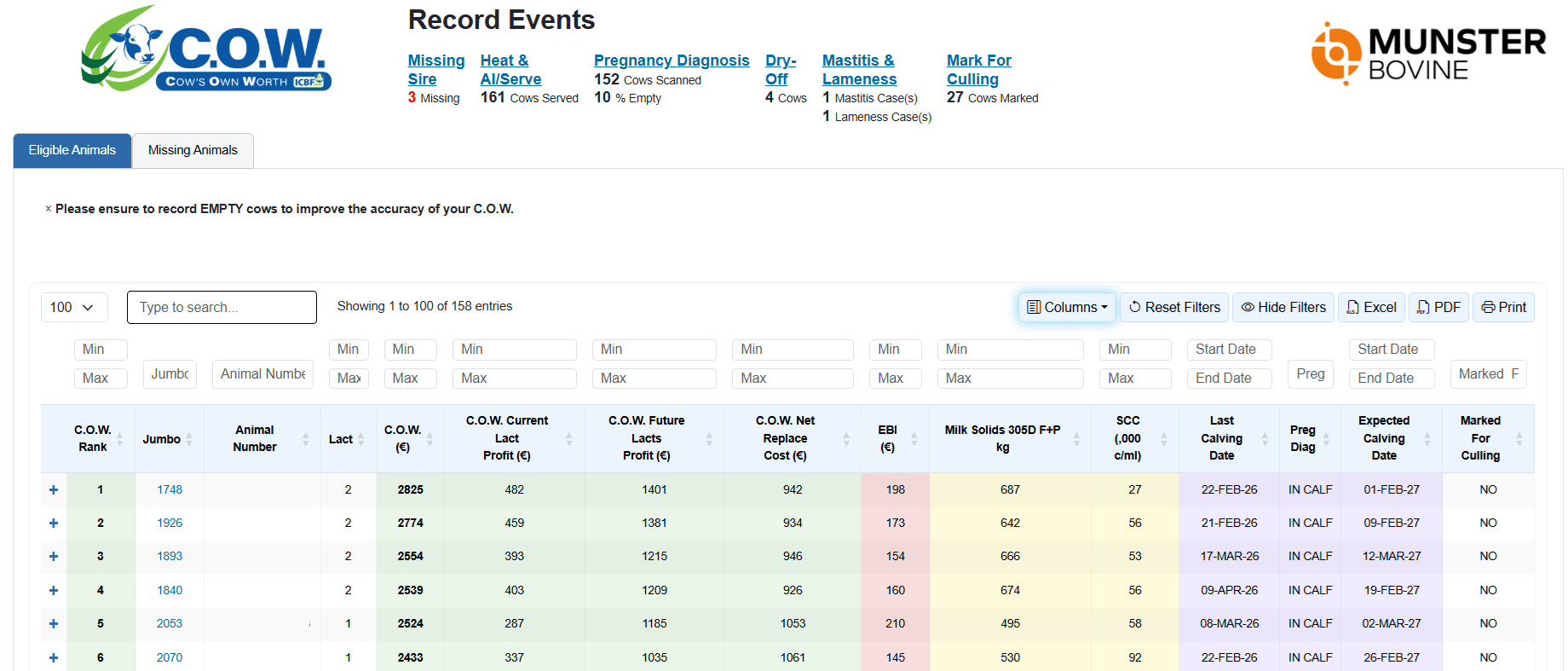
How is Profit Potential Calculated?
Each cow’s C.O.W. value is based on three key components:
- Current lactation profit
- Future lactation profit
- Net replacement cost
Together, these components estimate the financial value a cow is expected to contribute for the remainder of her lifetime.

Current Lactation Profit
This measures a cow’s expected profitability during her current lactation under prevailing milk prices.
The calculation considers factors including:
- Milk, fat and protein production
- Cull cow value
- Milking speed and temperament
- Mastitis and lameness
- Somatic Cell Count (SCC)
- Most recent calving date
Cows calving later in the season or recording higher SCC levels are penalised accordingly.
Expected performance is based on both the cow’s genetic merit and her own recorded performance, including milk recording data
Future Lactation Profit
This estimates the profit a cow is expected to generate in future lactations if she remains in the herd.
The calculation takes account of:
- Future milk production potential
- Fertility and survival
- SCC performance
- Calving performance
- Health traits
- Beef merit of progeny
- Future replacement daughters
Future calving patterns are also predicted using current calving date and genetic merit for calving interval. Earlier calving cows are rewarded, while cows likely to calve later in future lactations receive lower rankings.
The model also estimates the likelihood of cows remaining productive in the herd for future lactations, taking into account age, fertility and survival genetics.
Net Replacement Cost
This reflects the cost of replacing a cow, less her potential salvage value when culled.
The calculation considers:
- Cull cow value
- Replacement costs
- Genetic merit for carcass weight
- The fact that older cows may need replacing in the near future regardless of current culling decisions
Why Is My Cow Ranked Low on the C.O.W. Profile?
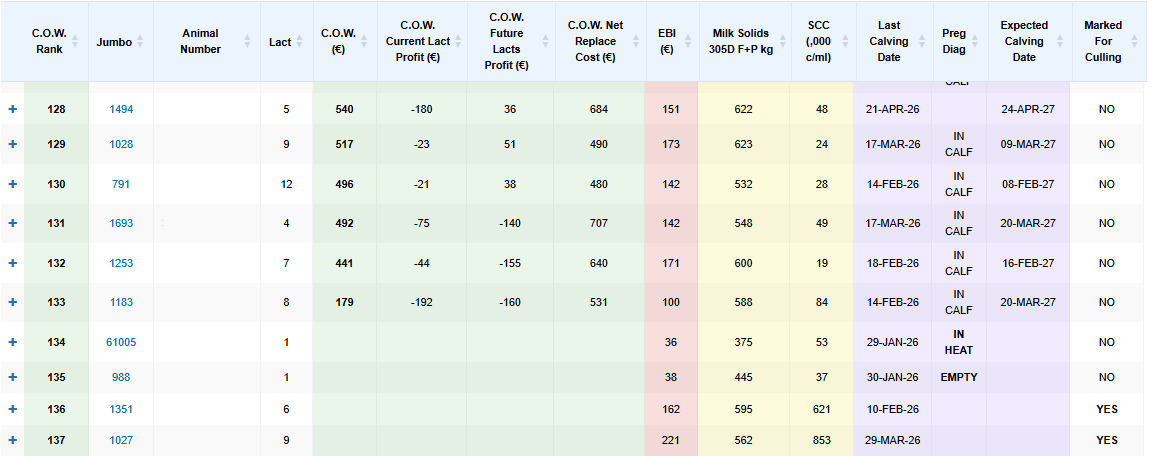
A cow’s ranking is always relative to the other animals in your herd.
For example, a cow may have strong replacement value but still rank poorly if her current and future profit potential are limited.
Common reasons for a low ranking include:
Somatic Cell Count (SCC)
Cows with consistently high SCC levels are likely to rank lower on the C.O.W. profile. High SCC can reduce milk value, increase treatment costs and indicate a greater risk of future mastitis. The C.O.W. calculation considers both current SCC performance and the cow’s likelihood of remaining in a high SCC category in future lactations, reducing her expected future profit potential.
Age Of The Cow
Older cows may rank lower due to a combination of factors including lower replacement value, reduced recent performance compared to herd mates, and an increased risk of falling behind the spring-calving system through later calving dates. These factors can reduce expected future profitability and lifetime value within the her
Poor Fertility Performance
Cows that slip in calving date, have longer calving intervals or weaker fertility genetics may be expected to produce fewer profitable future lactations.
Reduced Milk Performance
Declining milk production across lactations can negatively affect a cow’s profit potential.
Lower Genetic Merit
Cows with lower EBI compared to herd mates of a similar age and stage of lactation may rank lower due to reduced expected future profitability.
Getting the Most from Your C.O.W. Profile
To ensure the most accurate rankings, keep animal records as up to date as possible before making culling decisions.
1. Milk Recording
Milk recording is one of the most important data sources used by C.O.W.
It provides information on:
- Milk production performance
- Permanent cow effects
- Somatic Cell Count (SCC)
Cows with consistently high SCC or recurring issues will generally rank lower.
2. Fertility Recording
Calving dates, inseminations and pregnancy diagnoses play a major role in C.O.W. calculations.
Earlier calving cows are rewarded, while late-calving cows are penalised.
Empty cows automatically move to the bottom of the profile.
3. Health Recording
While SCC data is automatically incorporated through milk recording, recording additional health events such as mastitis, lameness and treatments will further improve the accuracy and relevance of C.O.W. rankings.
4. Mark for Culling
If a cow has already been identified as a culling candidate, marking her for culling in HerdPlus will automatically move her to the bottom of the list.
5. Genotyping
Genotyped females benefit from more accurate genetic evaluations, improving the reliability of C.O.W. predictions.
Genotyping also:
- Confirms parentage
- Identifies pedigree errors
- Improves confidence in genetic merit assessments