
ICBF in partnership with Teagasc are updating the dairy and beef evaluations this autumn. These changes are designed to make the indexes (EBI, Replacement, Terminal and DBI, more accurate and relevant to today’s farming conditions.
The Economic Breeding Index (EBI) has significantly contributed to the success of the Irish dairy sector in recent years, improving the national dairy herd’s production and fertility. However, continuous improvement is essential for Irish dairy farmers to breed the most profitable and resilient cows for the future. Following research work by ICBF and Teagasc, several improvements will be introduced to the EBI in the September Evaluation run. Farmers will see changes to their individual animals in their EBI profile, EBI reports and the Animal Search.
Economic Values in the EBI:
Why are the EBI economic values changing?
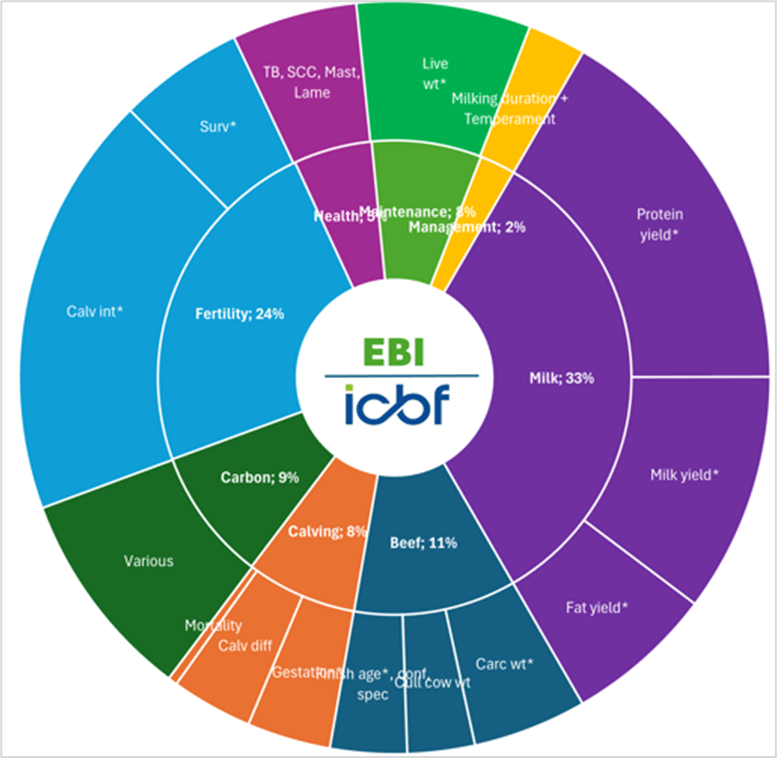
The EBI is calculated by assessing key traits that impact the profitability of dairy cows. These traits are grouped into categories such as milk production, fertility, calving performance, beef production, maintenance, and health. Each trait is assigned an economic value based on its impact on farm profitability. The genetic merit of an animal for each trait is assessed using breeding values. The EBI is then calculated by summing the economic values and the genetic merits for all traits to give the overall EBI figure.
Based on the latest data regarding economic values and costs of milk production in Ireland, Teagasc have updated the economic values in the Moorepark dairy systems model (MDSM), which are used in the formulation of the EBI. These updates account for rising input costs, such as increased feed and fertilizer prices, higher output prices and future market projections.
- Costs have risen: feed €370/t, fertiliser €550/t, labour €17/hour.
- Milk price is forecast at 40c/litre (incl. VAT) with a protein-to-fat ratio of 1.7:1.
- The heifer growth cost has been moved to the Maintenance Sub-Index which was previously accounted for in the Beef Sub-Index.
- These updates mean some sub-indexes (especially Beef and Maintenance) will change to reflect higher beef value and feed costs.
Overall, the impact of the economic values update and base change has had very little change on the relative emphasis. These economic updates ensure that the EBI accurately reflects the potential profitability of dairy cows under Irish farming conditions.
Base Change:
In genetic evaluations, a base is simply the reference group we compare all animals against. Think of it as the “starting line.” Each cow or bull’s genetic merit, or Predicted Transmitting Ability (PTA), is measured relative to this base group.
Example: if a sire has a PTA of +10 kg for fat yield and is mated to a base dam (PTA = 0 kg), his progeny are expected to yield, on average, 10 kg more fat than the base population if producing in the average environment.
Over time, the genetic potential of herds improves due to selective breeding. This means that today’s cows are, on average, genetically superior to the older base population of cows. To reflect the genetic improvements made in milk production and fertility in the Irish dairy herd, the base cow against which EBI is measured has been updated as part of the September 2025 evaluation.
- The old base cow was using cows born in 2005, first calved and milk recorded milk recorded in the 2007- 2009 period.
- The new base will use cows born in 2015, first calved and milk recorded in the 2017-2019 period

What can farmers expect to see?
The updated base will result in each animal’s EBI reducing by €97.
Updating the genetic base is just a reset of the starting line — it keeps evaluations up to date with today’s cows, but it doesn’t change the ranking of bulls or cows. While the PTA figures for all animals shift up or down, they all shift by the same amount.
Health and Management Evaluations:
What improvements are being made?
All genetic evaluations are periodically reviewed. Both the health and management genetic evaluations have been recently revised.
- Lameness and mastitis: We now use records from multiple lactations, so cows with repeated cases are better reflected in the evaluations.
- Temperament: The scale has been simplified from 5 points to 3 points, making it quicker and easier to score.
- Locomotion scores: Linear locomotion scoring is now used to help predict overall health, giving a clearer picture of mobility issues.
- Better data checks and calculations: We have improved the way information is cleaned and analysed, so the results are more reliable.
- More accurate evaluations: We now use the latest international “single-step genomic” method, which combines pedigree and DNA data in one step for greater accuracy.
While the figures will look significantly different initially, in general, aside from the base change, most herds will see minimal changes to their herd EBI. Combining the economic changes with the base change, farmers will see a reduction of approximately €83 on each animal.
By constantly reviewing and updating the evaluation system, ICBF is ensuring that the EBI remains current and reliable for farmers now and into the future.
Summary:
- Combining the economic changes with the base change, farmers will see a reduction of approximately €83 on each animal.
- The upgrades will provide improved health and management evaluations for farmers.
- The aim of the changes to the EBI is to help farmers accelerate genetic gain.
- EBI will continue to evolve, contributing towards improved profitability and sustainability of the national dairy herd into the future.