
The ICBF Beef Quality Awards, are proudly sponsored by FBD Trust alongside the main meat processors ABP, Ashbourne, Dawn, Foyle, Kepak and Liffey Meats. The awards recognise farmers who are achieving outstanding results through genetics, performance recording and efficient beef production. Meet the six Dairy Beef Finisher winners recognised at the 2026 ICBF Beef Quality Awards and learn more about the systems, breeding decisions and CBV performance behind their success.
Dairy Beef Finisher Tomás Mulhall Known for High-Quality Belgian Blues
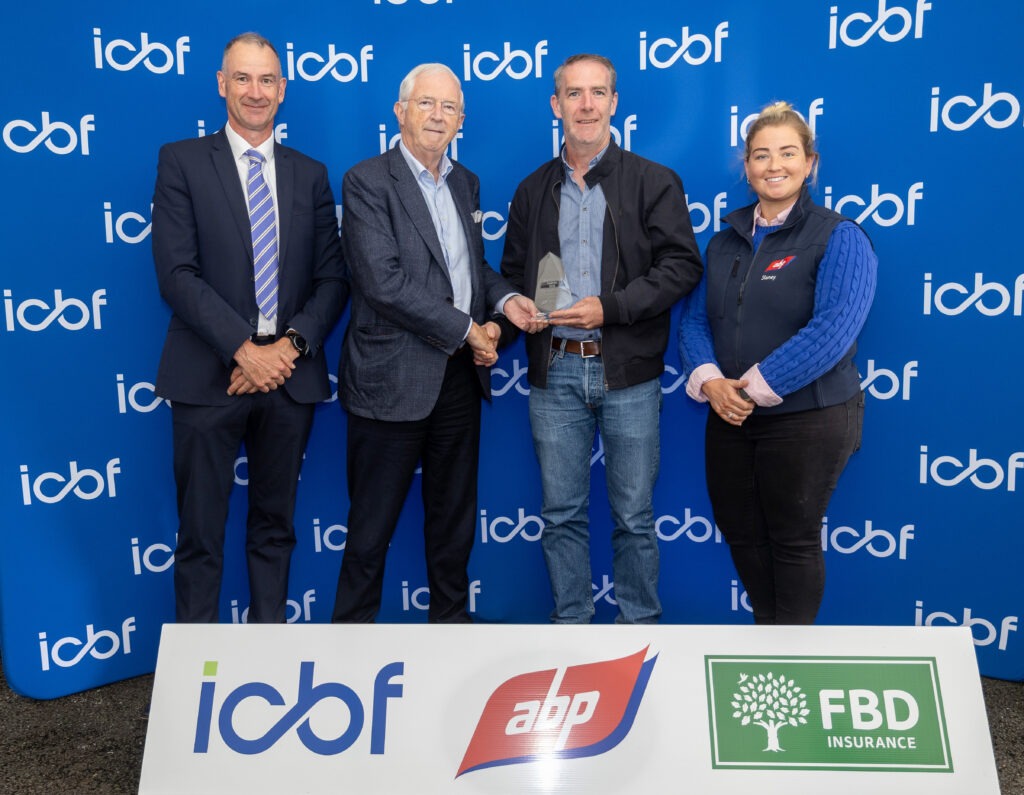
Third-generation Kilkenny farmer Tomás Mulhall finishes up to 200 dairy-beef animals annually for ABP alongside his father, Thomas. His system combines dairy-beef heifers and steers, with most sourced as three- to six-week-old calves from a small number of trusted dairy farmers and the remainder bought as stores when required. The calves, predominantly Belgian Blues, are brought through a grass-based finishing system and finished at an average age of 27 months.
Building a Dairy-Beef System Around Belgian Blues
Tomás has built a strong reputation locally for finishing high-quality Belgian Blue cattle. Sourcing the majority of his calves directly from 3-4 trusted dairy farmers allows him to maintain consistency and have greater input into sire selection.
Developing these direct relationships with dairy farmers who share this preference has been a key part of the system’s success. This arrangement benefits all parties, as the dairy farmers have a consistent customer each year to take calves during the busy calving season, while Tomás has direct input into sire selection to ensure the quality of calf he needs for his beef enterprise.
In the past, Tomás would have used tried and trusted, proven sires such as Manitou De Belle Eau (DBZ), but as the number of straws for these bulls has dwindled over time, he has had to focus more on the younger sires. “By the time a bull is proven, the straws could be all gone, particularly with Belgian Blues, so you are always trying to figure out what the next replacement for the likes of DBZ is.”
Allow Time to Mature and Maximise Compensatory Growth
The calves mature over two grazing seasons and spend two winters indoors. They are not pushed hard while housed, allowing Tomás to maximise compensatory growth when they return to grass. After the second winter, the cattle enter an intensive finishing period at grass, supplemented with meal, building up to meal ad-lib for the last 6 weeks.
Belgian Blues, as with most continental breeds, are later maturing, and Tomás likes to give them a bit more time to mature before putting them on a more intensive feed regime. “If you feed blues too hard too early, it can be very hard to get the fat scores up on them, they just keep growing. If you let them mature to the right age, it is a lot easier, which is why I am probably finishing them a little bit older than a lot of finishers”
CBV Performance Brings Confidence in the Science
Tomás has started to pay more attention recently to the Commercial Beef Value (CBV). The quality of the calves he will go onto purchase is driven primarily by sire selection from the previous breeding season. However, Tomás regularly buys more forward cattle such as stores to supplement his numbers, and CBV is becoming increasingly important in his decision making when purchasing these animals.
The quality of the cattle being finished from these selected Belgian Blue sires is reflected in the farm’s CBV performance. Dairy-beef heifers and steers had average CBVs of €292 and €286 respectively, highlighting the strong genetic merit of the animals entering the system.
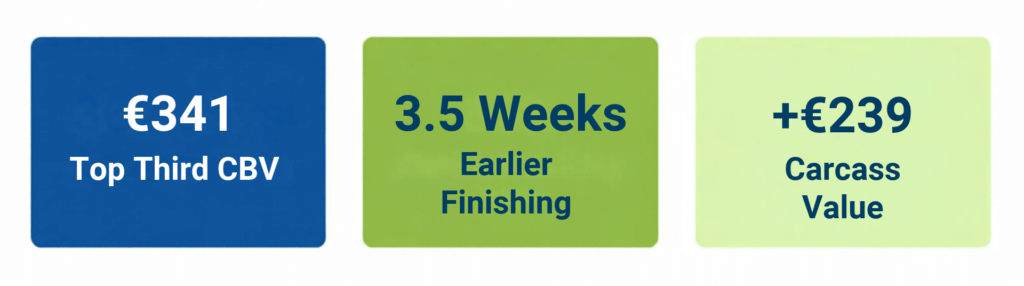
Among dairy-beef heifers, the top third for CBV averaged an impressive €341. These higher-CBV animals finished 3.5 weeks earlier, achieved a full carcass grade improvement and generated an additional €239 in carcass value compared to lower-CBV animals. These figures reinforce Tomás’s growing confidence in CBV as a tool when selecting cattle.
While he thinks it will take time, Tomás believes the CBV will become more and more important with time. “Now that I am aware of CBV, I can see it line up with the performance of the animals and that gives me confidence in the science behind it”
Vaccination Programme Critical to Calf Health
Herd health is another key component of the system. Every calf entering the farm is vaccinated against IBR and respiratory diseases, helping to maintain performance and reduce health-related setbacks. When asked to give one recommendation to other beef producers, Tomás immediately highlighted the importance of vaccination. “Not vaccinating is a slippery slope. You might escape for a few years but then when you do get hit, you can get hit hard. It is not just that the calves get IBR for example, but then their immune systems are low and they are more open to picking everything else that is on the go”
Making Life Easier in a Time of Uncertainty
Looking to the future, Tomás plans to continue to reinvest in the farm and improve efficiency wherever possible. Having recently completed a new shed, future plans include upgrading handling facilities, fencing, gates and other infrastructure.
“Anything that will make life a little easier.”
Despite the challenges facing the industry, Tomás remains focused on continuing to improve efficiency, infrastructure and cattle performance. Through strong calf sourcing, practical management, a proactive vaccination programme and an increasing focus on Commercial Beef Value, he has developed a system capable of consistently producing high-quality dairy-beef cattle.
While he acknowledges that uncertainty remains around issues such as input costs, calf prices and global beef markets, he remains optimistic about the future of the sector.
“Hopefully, prices will settle at a more sustainable long-term level over the next couple of years and there is still work to be done to raise awareness of dairy farmers to pick bulls with better beef sub-indexes.”
His recognition as the ABP Dairy Beef Finisher at the ICBF Beef Quality Awards 2026 reflects the success of that approach and the performance being achieved on the farm today.