
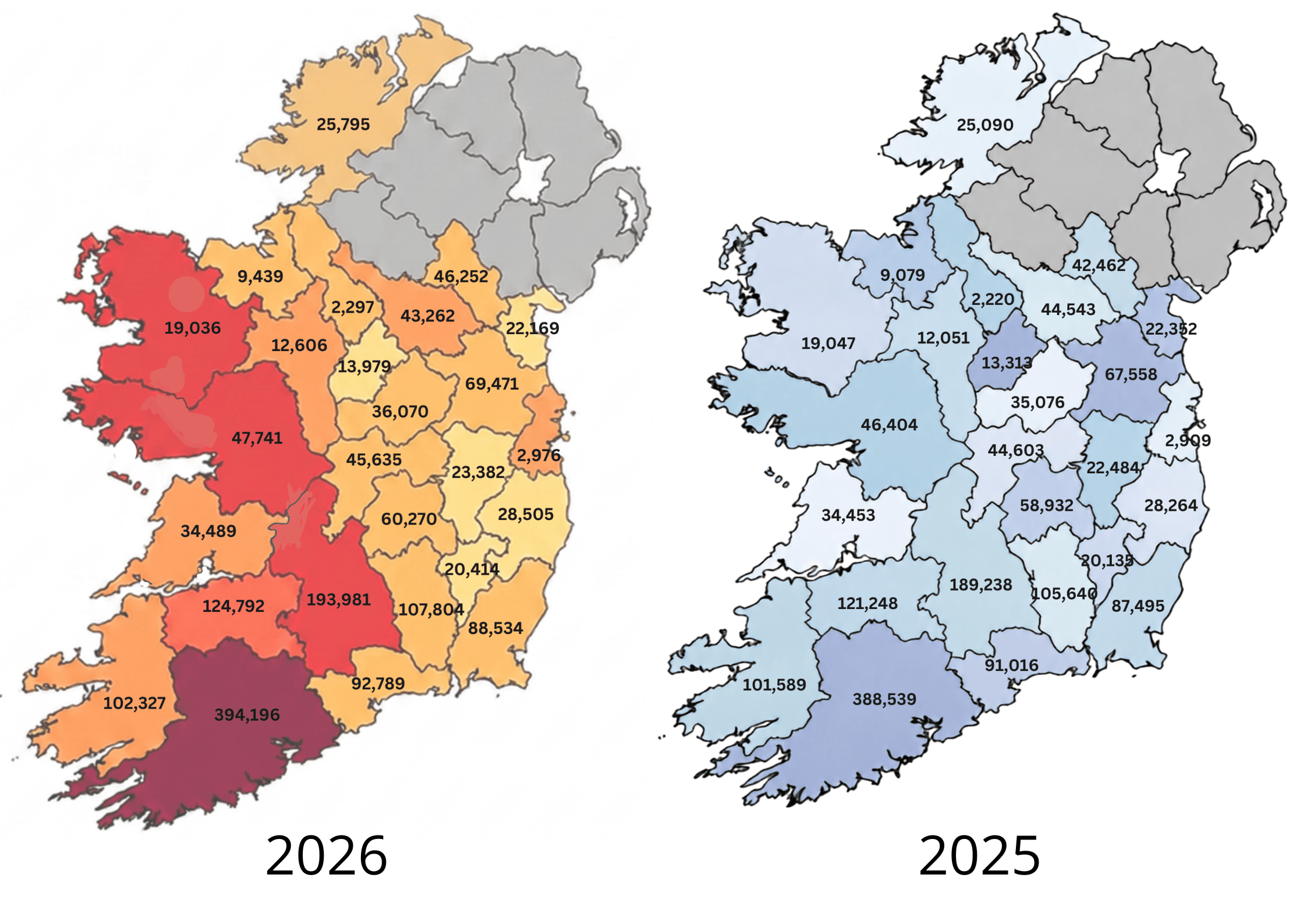
The latest ICBF analysis of dairy cow numbers by county in Ireland shows that the national dairy herd continued to grow in 2026. Total dairy cow numbers increased from 1,635,740 on 30 June 2025 to 1,668,211 on 30 June 2026, an increase of 32,471 cows or 2.0%. The county-level data provides valuable insight into the geographical distribution of Ireland’s dairy herd and highlights the counties with the largest dairy cow populations.
The figures point to a steady year-on-year increase in the national dairy herd, with growth recorded in the majority of counties. In total, 24 counties recorded an increase in dairy cow numbers between 2025 and 2026, while just two counties recorded a decline.
The data provides a clear county-level picture of where dairy cows are located across Ireland and how the national dairy herd is distributed. While dairy farming is present throughout the country, the 2026 figures show that dairy cow numbers remain highly concentrated in a relatively small number of established dairy regions.
Top 10 Counties for Dairy Cow Numbers in Ireland
Cork remains the largest dairy county in Ireland by a considerable margin. The county recorded 394,196 dairy cows in 2026, representing 23.7% of the national dairy cow population included in the analysis. This means that almost one in every four dairy cows in Ireland was located in Cork.
The scale of the Cork dairy herd places the county well ahead of every other county and reinforces its long-standing role as one of Ireland’s leading dairy-producing regions.
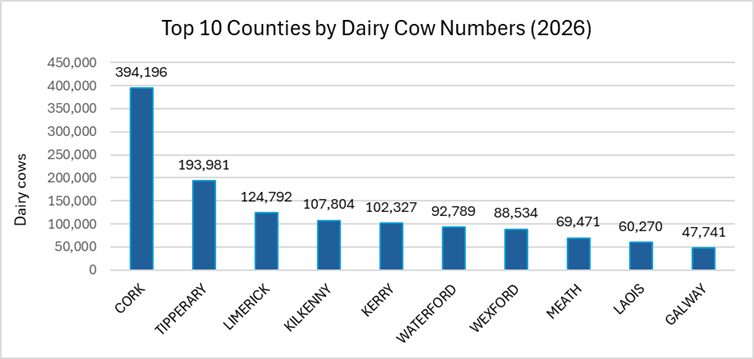
Figure 1: Top 10 counties for dairy cow numbers in Ireland in 2026. Cork recorded the largest dairy cow population (394,196), followed by Tipperary (193,981) and Limerick (124,792).
Tipperary recorded the second-largest dairy cow population, with 193,981 cows, followed by Limerick with 124,792, Kilkenny with 107,804 and Kerry with 102,327.
Together, these five counties accounted for 55.3% of all dairy cows in the 2026 dataset. This means that more than half of Ireland’s dairy cow population is located in just five counties.
The wider top ten also includes Waterford, Wexford, Meath, Laois and Galway. When these counties are included, the top ten account for 76.8% of the total dairy cow population. In other words, more than three-quarters of Ireland’s dairy cows are located within the ten largest dairy counties.
This demonstrates the strong regional concentration of dairy farming in Ireland, particularly across the south and south-east, where dairy activity remains most intensive.
This concentration is important when interpreting national dairy statistics. A small number of high-density dairy counties can have a significant influence on national figures, while counties with smaller dairy cow populations may have a more limited effect on the overall total. For example, Cork alone accounts for a larger share of the national dairy herd than the bottom eleven counties combined.
This highlights the importance of looking beyond national totals and examining dairy cow numbers by county to better understand the structure of Ireland’s dairy herd.
County Breakdown of Ireland’s 2026 Dairy Cow Herd
| County | 2026 Cows | Share of Total |
| Cork | 394,196 | 23.6% |
| Tipperary | 193,981 | 11.6% |
| Limerick | 124,792 | 7.5% |
| Kilkenny | 107,804 | 6.5% |
| Kerry | 102,327 | 6.1% |
| Waterford | 92,976 | 5.6% |
| Wexford | 88,534 | 5.3% |
| Meath | 69,471 | 4.2% |
| Laois | 60,270 | 3.6% |
| Galway | 47,741 | 2.9% |
| Cavan | 46,252 | 2.8% |
| Offaly | 45,635 | 2.7% |
| Monaghan | 43,262 | 2.6% |
| Westmeath | 36,070 | 2.2% |
| Clare | 34,489 | 2.1% |
| Wicklow | 28,505 | 1.7% |
| Donegal | 25,795 | 1.5% |
| Kildare | 23,382 | 1.4% |
| Louth | 22,169 | 1.3% |
| Carlow | 20,414 | 1.2% |
| Mayo | 19,036 | 1.1% |
| Longford | 13,979 | 0.8% |
| Roscommon | 12,606 | 0.8% |
| Sligo | 9,439 | 0.6% |
| Dublin | 2,976 | 0.2% |
| Leitrim | 2,297 | 0.1% |
Table 1: Dairy cow numbers by county in Ireland in 2026, including each county’s contribution to the national dairy cow population.
County-by-County Distribution of Dairy Cow Numbers
The average number of dairy cows per county in 2026 was 64,162. However, the median county figure was lower at 39,666. This difference shows that the average is influenced by a relatively small number of very large dairy counties, particularly Cork and Tipperary.
For this reason, the median provides a useful measure of the typical county-level dairy cow population, as it is less affected by exceptionally large dairy herds. The gap between the average and median figures confirms that dairy cow numbers are not evenly distributed across Ireland.
Counties in the middle of the rankings also play an important role within the national dairy herd. Cavan recorded 46,252 dairy cows, Offaly recorded 45,635, Monaghan recorded 43,262, Westmeath recorded 36,070 and Clare recorded 34,489.
While these counties do not rank among Ireland’s largest dairy counties, they support substantial regional dairy populations and make an important contribution to the overall dairy sector.
At the lower end of the rankings, Leitrim recorded the smallest dairy cow population, with 2,297 cows. Dublin followed with 2,976 cows, while Sligo recorded 9,439, Roscommon recorded 12,606 and Longford recorded 13,979.
Although these counties represent a much smaller share of Ireland’s dairy cow population, they remain part of the wider national dairy herd and contribute to dairy farming activity within their respective regions.
What Ireland’s Dairy Cow Numbers Tell Us
Overall, the 2026 figures show that dairy cow numbers in Ireland remain strongly concentrated in a relatively small number of key dairy-producing counties. The data provides valuable insight into the structure and geographical distribution of the national dairy herd.
For ICBF, these figures help support the analysis of breeding, recording and performance data across dairy herds throughout Ireland. They also provide useful context for regional reporting, service planning and future industry analysis.
The figures also underline the continued importance of using breeding and herd management tools such as the ICBF Dairy Active Bull List, Dairy Sire Advice, genomic testing and HerdPlus. These tools can help farmers make more informed breeding decisions and support the development of a more profitable, sustainable and efficient dairy cow for the future.