
How a consistent breeding strategy is delivering reliable performance and market‑ready calves on a large spring‑calving dairy farm in Co. Cork.
Mike Dunne farms in Kilworth, Co. Cork, just outside Fermoy, alongside his father, Tom. Together, they operate a spring‑calving, grass‑based dairy system, milking 400 Norwegian Red cows and supplying milk to Dairygold.
Norwegian Reds have formed the backbone of the herd for over 20 years, chosen for their fertility and ease of calving. With high cow numbers calving each spring and grass available early in the season, the system is built around a hardy, easy‑to‑manage cow. At the same time, there is a clear focus on continuing to improve milk volume, overall kilos of milk solids and, in particular, milk percentages.
Steady progress backed up by performance data
The results of this approach can be seen clearly in herd performance over time. Over the past five years, the Dunne herd has continued to move forward, with consistent gains reflected in the ICBF 5‑Year Trend Report. Improvements are evident across several key performance indicators, including Herd EBI and Herd Calving Interval.
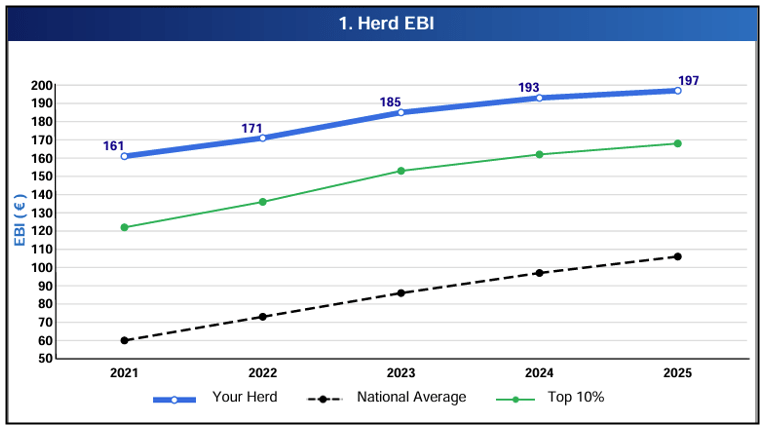
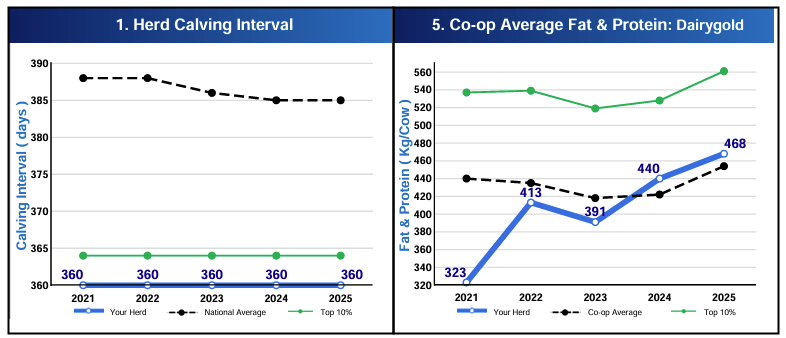
These improvements are driven by clear breeding priorities. Bull selection is guided first by milk percentages, followed closely by milk volume. With fertility already well established in the Norwegian Red herd, some crossbreeding with Holstein‑Friesian has been introduced over the past three to four years. This approach is being used selectively to capture hybrid vigour and help lift overall milk output.
Clear structure around breeding decisions
A defined breeding structure underpins day‑to‑day decisions on the farm. For the past three years, the Dunnes have operated a 100% sexed semen strategy, targeting the production of approximately 90 replacements annually. Typically, between 150 and 180 sexed semen straws are used each year before the system switches fully to beef semen.
Only cows that meet specific criteria are considered for sexed semen. These include having fewer than six lactations, being more than 60 days calved and having no previous calving difficulty. Selection is then narrowed further using EBI, with the bottom 10% removed. Milk solids performance, or future potential in heifers, also plays a key role.
Beyond this group, the next 25% of cows are bred to Holstein‑Friesian bulls to maximise hybrid vigour, while the remaining cows are bred back to Norwegian Red.
Dairy‑beef decisions guided by DBI
When it comes to beef breeding, decisions are driven by the Dairy Beef Index (DBI). ICBF breeding information is used to compare bulls across catalogues, with ease of calving a key requirement to ensure the spring‑calving system remains manageable.
As Mike explains, “the higher the DBI, the better the quality of calf, with a higher CBV, making them more saleable and easier to market”.
Building a reputation for quality calves
Around 80% of calves born on the farm are sold directly from the farm. Over the past 10 to 12 years, a core group of repeat buyers has returned year after year, reflecting their confidence in the consistency and quality of the calves produced.
This demand is closely linked to the use of higher‑DBI bulls with a strong Beef sub‑index. Gene Ireland sires have been used on the farm for the past six years, with Gene Ireland calves purchased directly by ABP. Depending on the year, between 30 and 35 calves are sold through this route.
For Mike, this provides a reliable and practical outlet during the busy spring period, supported by regular collections once or twice weekly and competitive prices.
Growing awareness of CBV
Producing calves with strong Commercial Beef Value (CBV) remains a central objective. Mike highlights the balance required between calving ease and carcass performance: “As a dairy herd, easy calving is a major priority, but good carcass weight is also essential to produce a valuable CBV calf. CBV is definitely becoming more widely used now, and it is starting to be displayed in some marts. Buyers are beginning to recognise that higher CBV calves represent better quality.”
Keeping spring management practical
Looking back on what has worked well, Mike stresses the importance of forward planning. His advice to other dairy farmers is to select bulls early in the year, follow DBI figures closely and pay particular attention to calving ease. Taking this approach, he believes, can make spring management far more straightforward