
High-CBV continental weanlings, disciplined management and a grass-driven system underpin the reliability and strong carcass results achieved on the Conway farm in Co. Westmeath.
When Ciarán Conway talks about cattle, he does so with the calm certainty of someone who has spent a lifetime looking at animals, weighing up systems, and making long term decisions. The farm in Westmeath traces back to his late mother, who tended 84 acres. “My mother was always a farmer and I just basically helped her. She farmed until the day she died in 2013.” Over the years the farm grew to just under 500 acres, a mix of owned and rented ground with his son Diarmuid leading the day-to-day work.
Originally the farm carried 150 ewes and a suckler herd. But one difficult year with BVD changed its direction. “We had weak calves everywhere. That made my mind up that instead of breeding sucklers, we’d start buying continental weanlings.” And so a continental weanling to finish system took shape, refined over the years into a consistent, high-performing operation.
The family has always been central to the farm’s momentum. His son, Eoin, recently returned home from Canada, Eadaoin works as a pig nutritionist, and Daire is an electrician. His wife Mary also helps with the cattle. Ciarán himself trained in UCD, graduating in 1983 with a degree in agricultural science, and has spent his career working as a beef nutritionist.
“There are four legs to any Animal production system,” he says. “Number one is genetics. Number two is animal health. Number three is nutrition. Number four is management. Genetics sets the potential; the rest is delivering on that potential.” It’s a philosophy that seems simply but requires consistent attention to detail.
The Conways buy most of their weanlings in the west of Ireland, “Those men have great pride in their stock,” Ciarán says. “They mightn’t have big numbers, but every cow is a good cow. They deserve every penny they get.” Heifers are the preferred choice here. They came into a carcass weight of 366kg, grading U= 3- at 24 months. consistently falling inside the specification range for Ashbourne Meats, who receive a load per week from the farm through the spring. Currently the suckler bred stock have an average CBV of €461, ranging from €182 to €614.
Grass is central to the entire system. Land is laid out in paddocks to maximise utilisation and barley is incorporated as a rotational crop for reseeding. “Grass is cheap,” he says. “Anything we can do to grow more of it and get it into cattle, we do. From an Ireland-Inc point of view, grass-fed beef is our strength.” Cattle are bought in spring, turned out quickly, and spend the season at grass before coming in for finishing. Emphasising the importance of reducing stress for cattle at all times. The Conways have successfully integrated a dairy-heifer contract rearing enterprise, which helps diversify their income throughout the year, while also aiding grassland management.
The real focus begins the moment cattle arrive from the mart. Ciarán is clinical in describing the stresses on cattle: “They could be up at five in the morning in the west, into the mart, mixed with cattle from everywhere, loaded again that evening- the stress knocks the immune system. The first thing is rest. The second thing is vaccinations.” Every bought animal is vaccinated for Pasteurella and IBR, and receives Multimin to support the immune response. “If the immune system is compromised, the vaccine won’t work. One dead animal pays for all the vaccines.”
Dosing is done on need, not routine. Lungworm is watched carefully. “A lot of continental calves never get enough exposure in year one as grass intake is low, so year two is where the trouble hits.” He also noted “Lice has a massive effect on the thrive rate for cattle in the Shed.”
Once housed, cattle are eased onto a finishing diet. Ciarán’s experience as a nutritionist means he keeps a close eye on the beef-to-meal price ratio. “Four years ago it was maybe 8 or 12 to 1. Now it’s about 24 to 1. It’s paying farmers to push cattle on. That shift has made some feed additives viable that never previously made sense in beef.“ Protected fats like Megalac… I can show 0.2 kilos extra gain a day. If it costs 40 cent and gives an extra euro in liveweight, that’s a two-and-a-half to one payback.”
Finishing age is tightly managed around nitrates. “That’s our biggest constraint. I want to stay under the 170 band. So most cattle are gone around 24 months.” CBV helps to identify cattle that will finish earlier, eat less, while achieving superior weights and grades.
Across the year, the farm finishes roughly 350–360 animals. The system isn’t built on outliers or extremes. It is built on reliability. “It’s Mr. Average pays the bill,” he says. “Not the extreme lad, either extremely good or extremely bad.
That reliability ties closely to the CBV values of the cattle that pass through the Conway yard. The numbers behind the animals consistently match the performance in the shed. “When you’re buying cattle, the more information you have, the better. Genetics sets the bar. It’s up to me to reach it.”
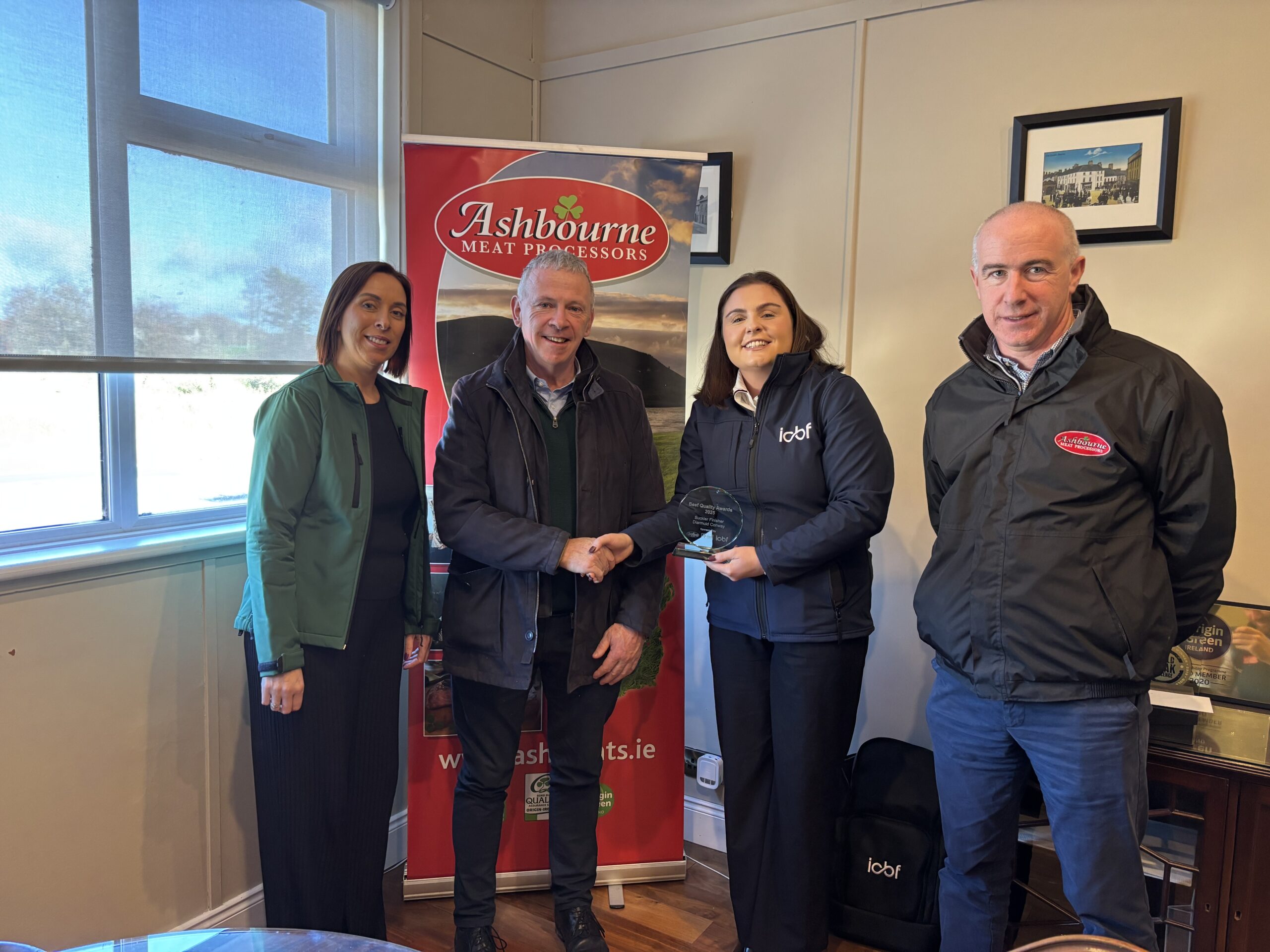
ICBF would like to congratulate the Conway family on achieving the 2025 Suckler Finisher Award for Ashbourne.
For more information on the Commercial Beef Value (CBV), click here.
