
How does your herd compare? The latest Beef Calving Report highlights key fertility and efficiency indicators, helping suckler farmers identify strengths, weaknesses and opportunities for improvement.
2026 Beef Calving Reports Now Available
The 2026 Beef Calving Reports have recently been issued to HerdPlus suckler herds. The report summarises herd calving performance for the period 1 July 2025 to 30 June 2026 and provides valuable insight into key fertility and efficiency indicators.
Among the key performance indicators (KPIs) included in the report are:
- Average calving interval
- Calves per cow per year
- Percentage of heifers calving between 22 and 26 months of age
- Spring 6-week calving rate
- Calving survey recording rates
- Calf mortality statistics
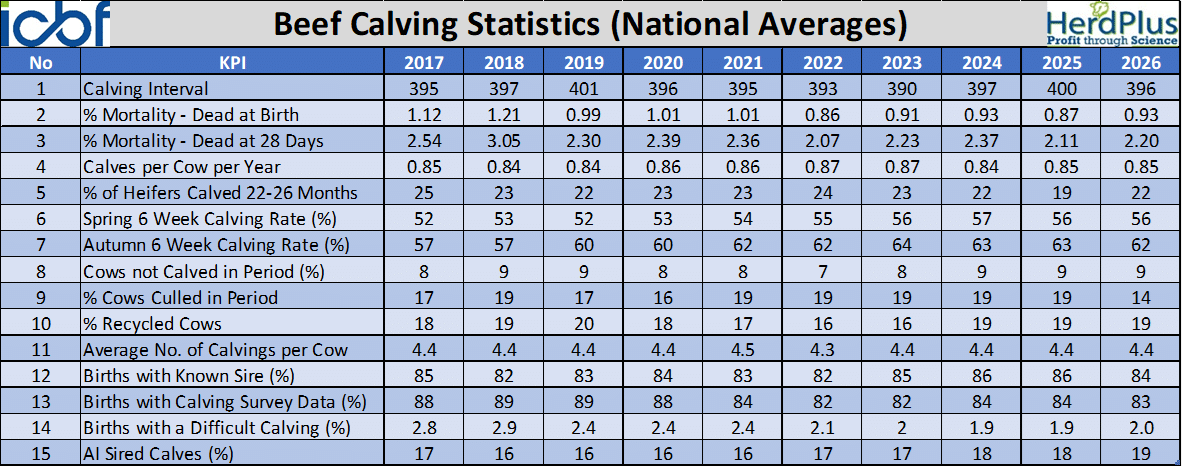
Table 1 below outlines the national averages for the main beef calving KPIs over the last 10 years.
Calving Interval
The national average calving interval improved slightly in 2026, decreasing to 396 days. While this represents progress, it remains some distance from the target of 365 days.
A calving interval of 396 days means the average Irish suckler cow is producing a calf approximately every 13 months. Improving fertility performance and maintaining a compact calving season remain critical to increasing herd profitability.
Encouragingly, more than 6,000 herds are already achieving an average calving interval of 375 days or less, demonstrating that significant improvements are achievable through good management and fertility practices.
Calves per Cow per Year
This KPI measures overall herd productivity by assessing how many calves are produced per cow in the herd annually.
The national average currently stands at 0.85 calves per cow per year, meaning that every 100 suckler cows are producing approximately 85 calves.
A number of factors can impact performance, including:
- Cows failing to go in calf
- Pregnancy losses
- Calf mortality
While some losses are inevitable in any production system, there is scope for improvement in many herds. Farmers should aim for a target of 0.90 calves per cow per year or greater.
Heifers Calving at 22-26 Months
The age at which replacement heifers calve for the first time remains a key topic within the suckler sector.
Nationally, just over 20% of suckler heifers calve between 22 and 26 months of age. In comparison, approximately 76% of dairy heifers achieve this target.
Research continues to highlight the benefits of earlier calving ages:
- Improved lifetime profitability
- Reduced rearing costs
- Lower methane emissions before first calving
- Earlier return on investment from replacement females
In addition, ICBF research has shown that calving heifers at 24 months does not negatively impact their future survival within the suckler herd.
More than 1,400 herds are already achieving a figure of 75% or greater for heifers calving between 22 and 26 months, demonstrating that this is an achievable target when supported by good management and appropriate sire selection.
Making the Most of Your Beef Calving Report
The Beef Calving Report provides farmers with much more than a set of figures. It is designed to help identify opportunities for improvement within the herd.
Review each KPI carefully and compare your herd performance against both national averages and recommended targets. Where performance is below target, investigate the possible causes and identify areas that may require attention.
Each report also includes an Action List, highlighting animals that may be impacting overall herd performance, including:
- Cows with extended calving intervals
- Cows that experienced difficult calvings
- Recycled cows that have slipped from one calving season to another (for example, from spring to autumn)
By focusing on these animals, farmers can make informed management decisions that improve herd fertility, productivity and profitability.
Need Help?
If you have any questions about your Beef Calving Report, contact the ICBF support team:
📞 023 8820452
📧 [email protected]