The ICBF Animal Search allows farmers, breeders and industry users to search for eligible Beef and Dairy animals on the ICBF database and view their EBI and EuroStar information where available. Animals can be searched using an animal tag, AI code, herd book number, or animal name.
What information can I find?
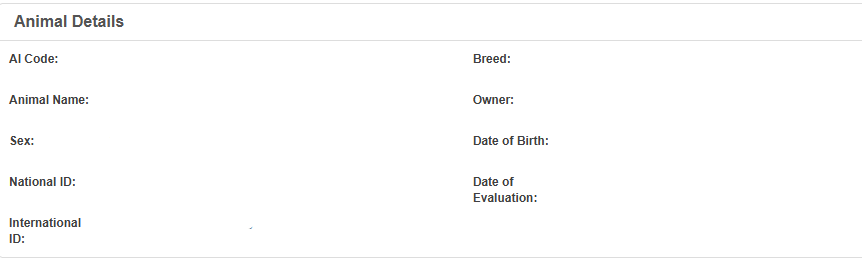
When an eligible animal is selected, Animal Search can display important identification, pedigree and genetic evaluation information. This includes:
1. Animal Details:
- Animal name
- National and international ID
- Sex
- Breed
- Date of birth
- Owner
- AI code, where applicable
- Pedigree status
- Date of the animal’s evaluation
2. Pedigree and ancestry
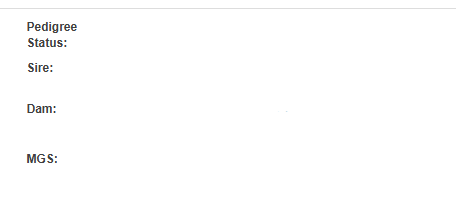
Animal Search can also provide pedigree information, including the animal’s:
- Sire
- Dam
- Maternal grandsire (MGS)
- Sire verification information, where available
- Genotype information, where available

How to Search for an Animal
- Open ICBF Animal Search – Search ICBF Animal Search on Google
- Search for your animal – Enter an animals Full Tag Number, AI code, HerdBook Number or Animal Name
- Select the animal
- For beef animals – choose the relevant index: choose either Replacement and Terminal or Dairy Beef
- Explore the animals information – Review the identification of the animal, it’s pedigree and any other information available
Beef Animals
If the information is available for beef animals the following tabs will be displayed when an AI code or an animals tag number is searched on the ICBF Animal Search:

Each of the tabs above can be clicked into to display more information on the animal.
If the information is available on beef animals, users will have access to the following information on beef animals:
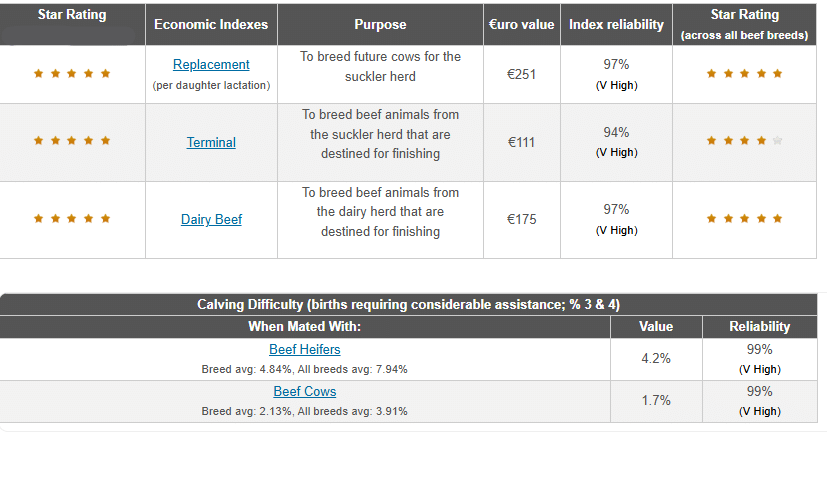
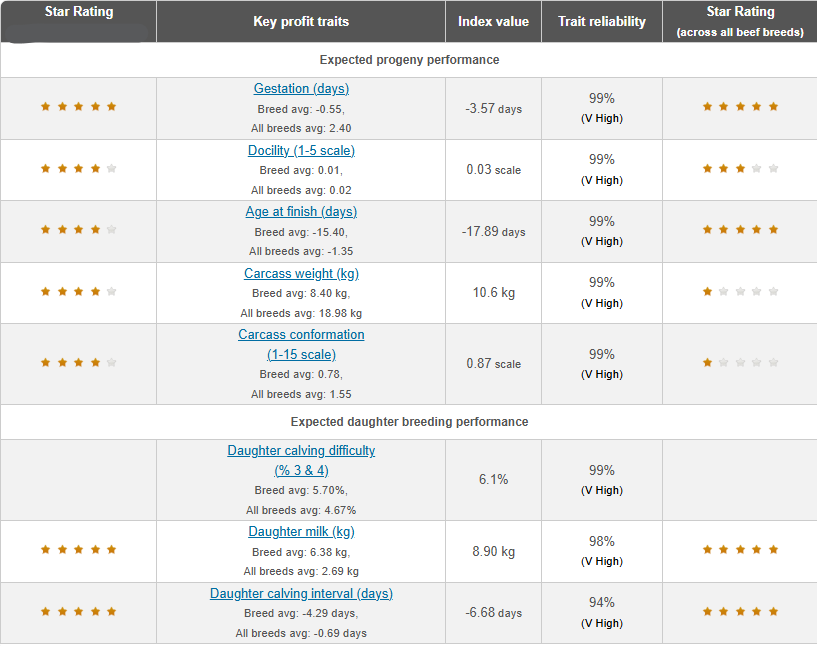
Each of the tabs below can be clicked into to display more information on the animal.

The toggle that is highlighted above can be clicked to display the Dairy Beef information on a particular beef animal:
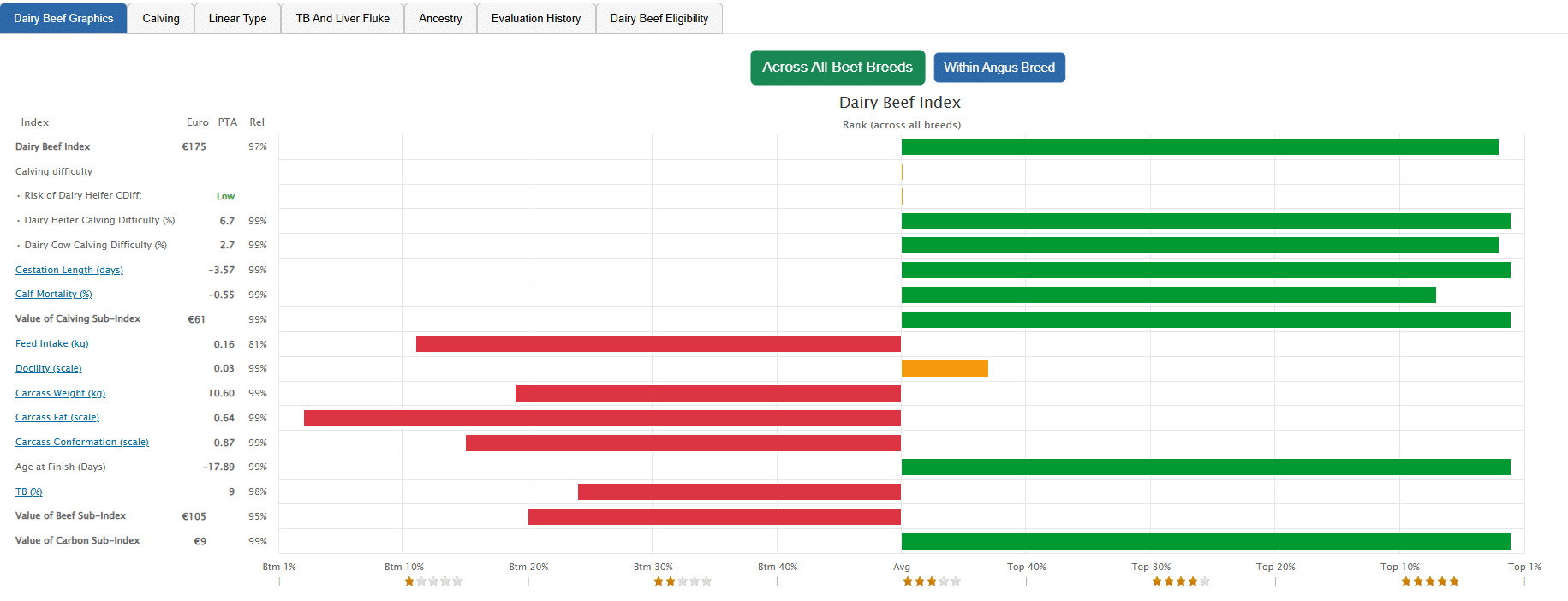
Understanding the graph
The coloured bars provide a quick visual indication of how an animal ranks for each trait. The centre of the graph represents the average, with animals ranking towards the Top 1% displayed further to the right and animals ranking towards the Bottom 1% displayed further to the left.
🟢 Green bars to the right = the animal ranks more favourably for that trait.
🟠 Orange bars around the middle = the animal ranks closer to average.
🔴 Red bars to the left = the animal ranks less favourably for that trait.
Users can also switch between Across All Beef Breeds and Within Breed to see how the animal compares with different populations
Across All Beef Breeds = Compares the animal’s ranking across beef breeds
Within Breed = Compares the animal to other animals of the same breed
Dairy Animals
Use ICBF Animal Search to find dairy animals and view their genetic evaluation information. Animals can be searched using their tag number, AI code, herd book number or animal name.
Once an animal is selected, users can view its EBI and genetic evaluation information, helping them assess the animal’s genetic merit and individual traits.
Choosing the Right Dairy Bull for Your Herd
Rather than looking at EBI alone, farmers should consider the bull’s individual sub-indexes and traits in relation to their own herd’s strengths and weaknesses.
For example:
Milk
- Milk kg
- Fat kg
- Protein kg
- Fat %
- Protein %
Fertility
- Fertility performance
- Calving interval
- Survival
Calving
- Calving difficulty
- Gestation length
- Calf mortality
Health & Management
- Health traits
- Management-related traits
- Other individual traits available within the bull’s evaluation
Top Tip: Use the HerdPlus EBI Report to identify traits that need improvement, select a team of bulls that improves those traits, and then use HerdPlus Sire Advice to allocate those bulls to suitable cows
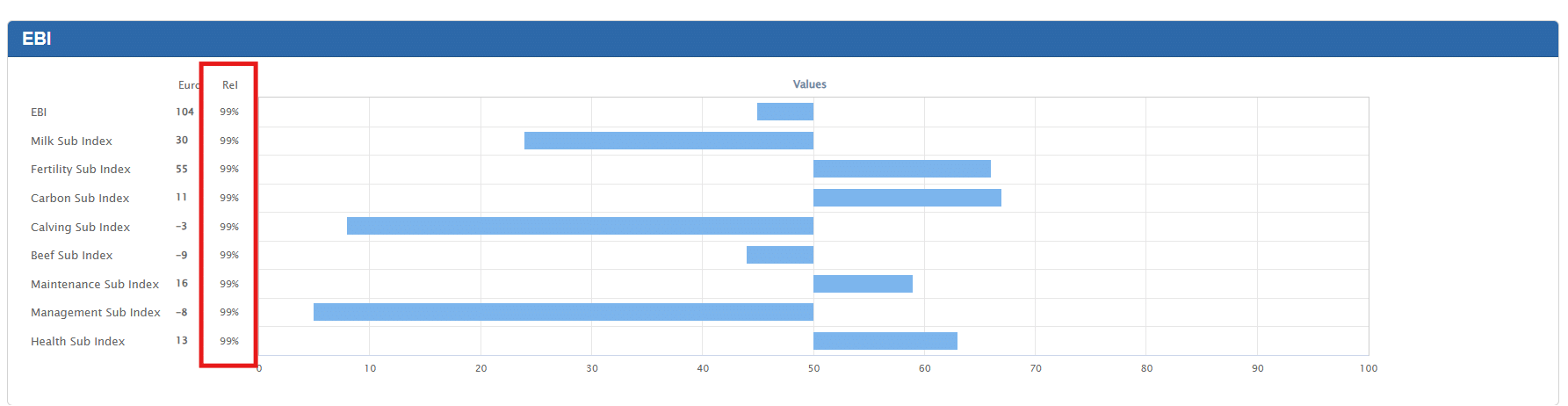
When looking at the graphs on the Animal Search page for dairy animals on the EBI Summary tab remember:
Reliability indicates the level of confidence in an animal’s genetic evaluation. Reliability is influenced by the amount and type of information available for the animal and its relatives. Generally, more information leads to greater reliability. A higher reliability means there is greater confidence in the figures shown.
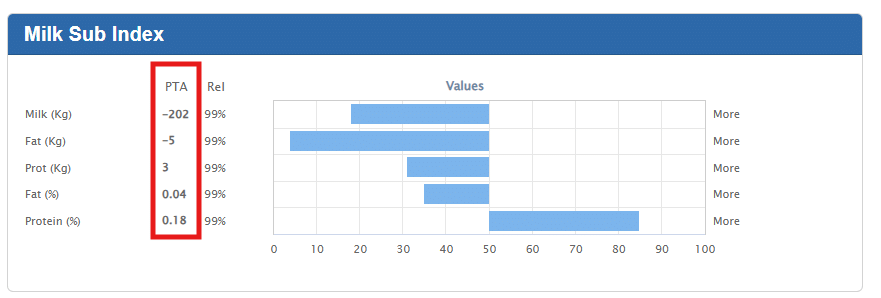
Predicted Transmitting Ability (PTA) shows the genetic potential an animal is expected to pass on to its offspring for a particular trait. PTAs are measured relative to the ICBF base cow, whose PTA is zero. For example, if a bull has a +10 kg PTA for fat, progeny from that bull and a base dam are expected to produce, on average, 10 kg more fat than the base population under average conditions. Farmers should pay particular attention to PTAs for traits they want to improve within their herd.
ICBF Animal Search App
The animal search function can also be viewed on the ICBF Animal Search App – Search in your app store.