
Know which cows are making you profit — and which aren’t.
Introduction to Cow’s Own Worth
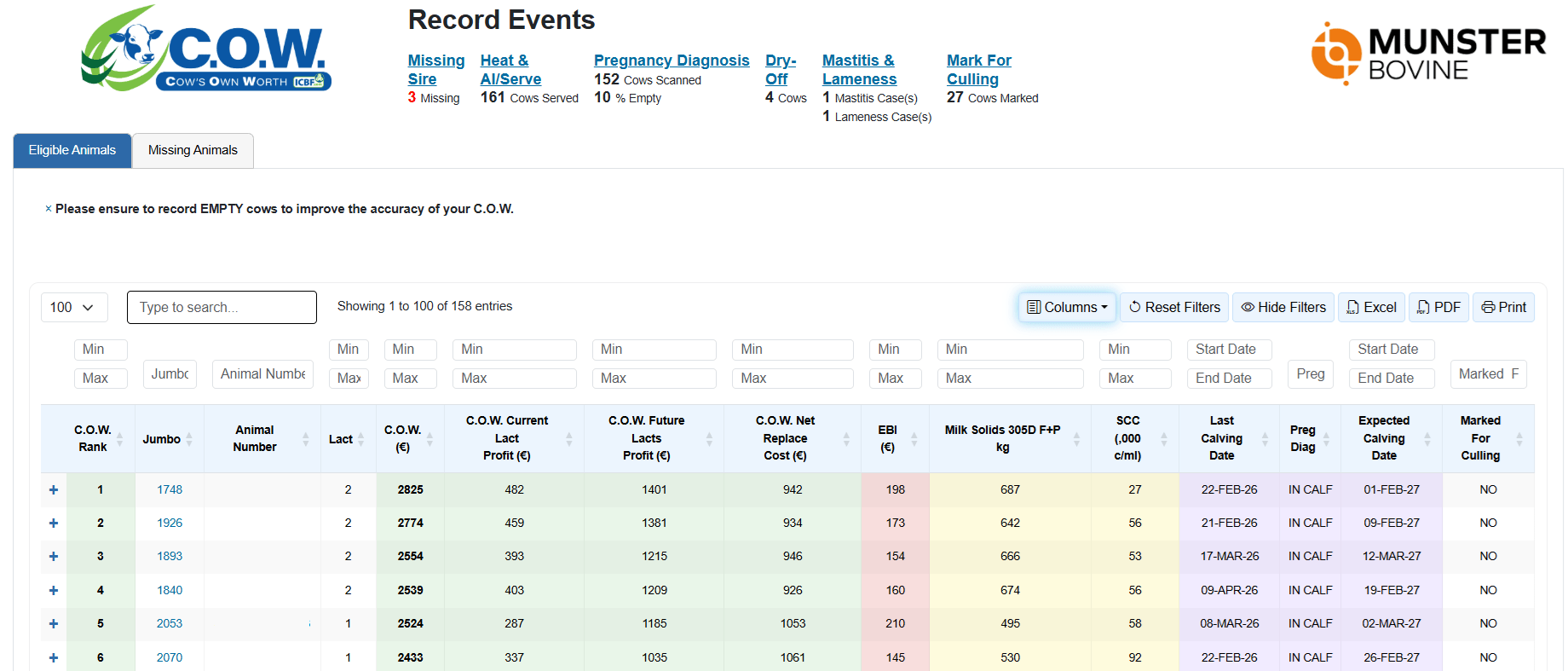
The Cow’s Own Worth (C.O.W.) index ranks every cow in your herd by the profit she is expected to earn for the rest of her life. It is an award-winning culling tool for spring-calving, milk-recording dairy herds, and it is available in your ICBF HerdPlus account on both desktop and mobile version of the ICBF website under the profiles section.
You already record calvings, and perhaps other key data such as milk recordings, inseminations, scans, health events and genotypes. The C.O.W. index pulls all of that into one € figure per cow, so the culling decision is based on the whole picture rather than a single piece of information or a snapshot in time.
The C.O.W. index is:
- Live: the ranking updates as soon as new information is recorded.
- Simple to read: your best cows are at the top, your weakest at the bottom.
- A cull decision aid: check out the bottom of the list for your voluntary cull decisions – cows with lower predicted profit expected compared to other herd mates. Cows recorded as empty, or marked for culling, drop to the bottom automatically
EBI & C.O.W? Use the right index for the right decision
EBI is for breeding. C.O.W. is for culling.
| EBI | COW | |
| Use it to | Choose the parents of your replacements | Decide which cows stay and which go |
| Measures | Genetic merit only — what she passes on | The whole cow — genetics plus her own performance and circumstances |
| Changes with age or calving date? | No — genetics are fixed for life | Yes — age, calving date, yield, SCC and health all count |
A cow’s value in your herd depends on more than her genes. For example:
- A high-EBI heifer that is empty after the breeding season is a cull candidate.
- An 8th-lactation cow due to calve next February, with good milk solids and low SCC, may earn another season.
- A 2nd-lactation cow is worth more than a 5th-lactation cow, if all else is equal between them (e.g. same calving date, EBI) because she has more productive years ahead of her and therefore greater potential to generate future profit.
Don’t use C.O.W. to pick your breeding replacements. It will slow the genetic gain in your herd. Use EBI for that.
How is the C.O.W. value calculated?
Each cow’s C.O.W. value is the sum of three parts, in €:
C.O.W. = Current lactation profit + Future lactation’s profit + Net replacement cost

1. Current lactation profit
What she is expected to earn this lactation at the current milk price. It takes account of:
- Milk, fat and protein yield
- Cull cow weight
- Milking speed and temperament
- Mastitis, lameness and SCC
- Her most recent calving date or expected calving date generated from breeding and/or scanning records. As new information becomes available, the C.O.W. index automatically updates to reflect this.
Later calving and high SCC are penalised. Milk production values use both her genetic merit (including crossbreeding effects) and her past performance within your herd to benchmark against her herdmates.
2. Future lactation profit
What she is expected to earn if she stays in the herd. It takes account of:
- Future milk, fat and protein yield
- Fertility and the chance she survives to later lactations
- Future SCC
- Calving difficulty and calf mortality
- Beef merit of her progeny
- The value of her future replacement daughters
Future fertility performance is predicted by combining a cow’s current calving date with her genetic merit for calving interval and mapping her to similar cows in the national population data. This predicts her calving pattern in future years. Cows expected to calve earlier and stay fertile are rewarded; cows likely to slip later are ranked lower.
3. Net replacement cost
The cost of replacing her, less what she is worth as a cull cow. It takes account of her genetic merit for carcass weight. It also allows for the fact that an older cow would need replacing soon anyway, so culling her costs less compared to culling a young cow.
Why is my cow ranked low?
A cow’s rank is always relative to the rest of your herd. Don’t stop at the total — look at the three parts behind it to see why she is where she is.
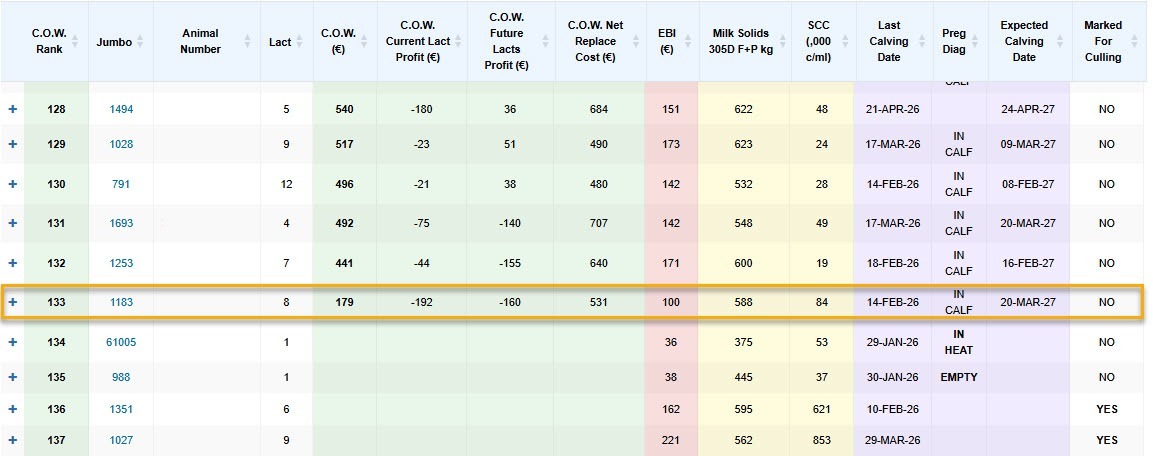
| Part | Value |
| Current lactation profit | –€192 |
| Future lactation profit | –€160 |
| Net replacement cost | +€531 |
| C.O.W. value | €179 |
Why she is near the bottom:
- Age: she is in her 8th lactation, so she has fewer profitable years left and costs less to replace.
- Calving slipping: she calved on 14 February but isn’t expected to calve again until 29 March.
- Genetic merit: her EBI (€100) is below many of the cows ranked above her.
The usual reasons a cow ranks low are:
- Late calving now, or expected to calve later next year
- Falling milk solids compared with earlier lactations
- Fertility slipping — a longer calving interval
- Age
- Low EBI
- High SCC, or recorded mastitis and lameness
The C.O.W. index is particularly useful for identifying “passenger” cows. These are cows that don’t have any obvious problem, good SCC, good fertility and a respectable EBI, but consistently underperform their peers. For example, a 2nd-lactation cow may appear to be a keeper, yet her milk production may have been well below average both this year and last year. The C.O.W. index recognises that this pattern is unlikely to change and ranks her accordingly, helping to identify cows that may be limiting overall herd profitability.
Get the most from C.O.W.
C.O.W. is only as good as the information behind it. Before you use it to make culling decisions, make sure your records are up to date.
- Milk recording: this is one of the most important data sources. It shows whether a cow is doing better or worse than her genetics predicts, supplies her SCC, and also considers past performance within the herd for these traits. Cows with low milk performance are ranked lower, and cows with high or recurring SCC are ranked lower.
- Fertility recording: calving date alone explains 18% of the difference in C.O.W. between cows. Record calvings, inseminations and scanning results. Record empty cows — they go straight to the bottom of the profile.
- Health recording: SCC comes from milk recording, but mastitis, lameness and other treatments only count if you record them. Using a herd-management app that syncs with ICBF makes this easier.
- Mark for culling: cows you have already decided to cull can be marked, and drop to the bottom with the other cull candidates.
- Genotyping: genotyped females get a more accurate C.O.W., because their true genetic merit is better known. Genotyping also confirms parentage and corrects pedigree errors.
Does it work?
Yes. A validation study in 2015 showed that cows in the top 25% on C.O.W. were worth €360 more per lactation than cows in the bottom 25%. For a 100-cow herd, that is roughly €9,000 a year.
ICBF tested C.O.W. by ranking cows on national data, then checking how those cows actually performed a year later. Cows ranked higher produced more milk and more milk solids. They also calved earlier in the season than lower-ranked cows. The €360 figure uses the A+B–C milk pricing system.
What people are saying about Cow’s Own Worth
TeamAg advisor Páidí Kelly uses C.O.W. with more than 100 farm businesses. His advice is to look past the headline figure to the parts behind it — milk solids, calving date, SCC and health events, age and EBI. That is how you build trust in the ranking.
Read Páidí’s full case study →
Listen: On Teagasc’s Dairy Edge podcast, ICBF’s Dr Margaret Kelleher explains how C.O.W. ranks your cows and how to use it to pick out the bottom 10–15% for culling.
Get started
Open the C.O.W. profile in your ICBF HerdPlus account to see which cows have the most profit potential in your herd.
Want help getting started? Contact the HerdPlus office.