What is Liver Fluke resistance?
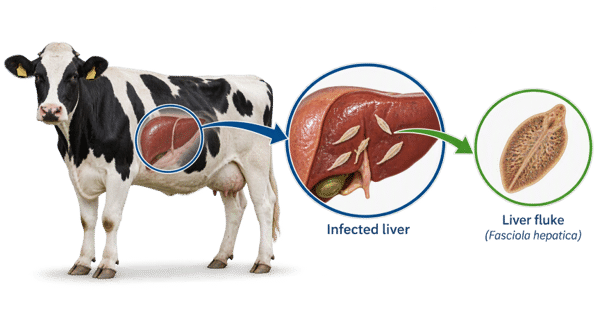
Liver fluke is a common parasitic disease of cattle in Ireland that can negatively affect animal health and performance. Approximately one in every five cattle slaughtered in Ireland is diagnosed with liver fluke infection.
Cattle can become infected when grazing on contaminated pasture. While management and environmental conditions influence the risk of liver fluke infection, genetics also play a role in an animal’s ability to resist infection.
Anthelmintic treatments can help control liver fluke when used correctly. However, their use can be more challenging in dairy herds because of associated milk withdrawal periods, while inappropriate use can also contribute to anthelmintic resistance.
Some cattle are naturally more resistant to liver fluke than others because of their genetics. By selecting animals with better genetic resistance, farmers can breed cattle that are less likely to be diagnosed with liver fluke infection.
Breeding for liver fluke resistance is a long-term approach that complements existing liver fluke control and management strategies.
Understanding Liver Fluke PTA
Liver fluke resistance is expressed as a Predicted Transmitting Ability (PTA %). The liver fluke PTA indicates the expected prevalence of liver fluke infection among an animal’s progeny.
Lower liver fluke PTA values are more desirable, as they indicate that fewer offspring are expected to be diagnosed with liver fluke.
For example:
| Bull | Liver Fluke PTA | Expected Cases |
| Bull A | 12% | 12 in every 100 progeny |
| Bull B | 6% | 6 in every 100 progeny |
Remember: lower is better. Based on liver fluke resistance alone, Bull B would be the preferred choice, as fewer of his progeny are expected to be diagnosed with liver fluke.
Did you know?
In ICBF research, 36% of cows predicted to be in the highest-risk genetic group for liver fluke were diagnosed with liver fluke at slaughter, compared with 30% of cows predicted to be in the lowest-risk group.
Using Liver Fluke PTA when selecting breeding animals
Animals can receive a liver fluke genetic evaluation even if animals in their own herd have not been diagnosed with liver fluke. Genetic evaluations use available records and pedigree relationships to estimate an animal’s genetic resistance.
For the genetic evaluation itself, ICBF applies criteria designed to ensure animals being compared had a similar likelihood of exposure to liver fluke.
When selecting breeding animals, farmers should consider liver fluke PTA alongside other economically important traits and the animal’s overall genetic merit.
Combining good herd management with genetic selection can help reduce the incidence of liver fluke over time.
Key Messages
- Lower liver fluke PTA values are better and indicate that fewer progeny are expected to be diagnosed with liver fluke.
- Selecting animals with better genetic resistance can help reduce the incidence of liver fluke over time.
- Liver fluke PTA should be considered alongside overall genetic merit and other economically important traits when selecting breeding animals.
- Genetic selection provides a long-term and cumulative approach to improving liver fluke resistance.
- Breeding for liver fluke resistance complements rather than replaces appropriate liver fluke control and management.
Frequently asked questions
Is a high or low liver fluke PTA better?
Lower is better. A lower liver fluke PTA means fewer of an animal’s progeny are expected to be diagnosed with liver fluke.
Can cattle be bred for resistance to liver fluke?
Yes. Research has identified genetic differences between cattle in their susceptibility to liver fluke infection. ICBF’s genetic evaluation allows these differences to be considered when making breeding decisions.
Why does my animal have a liver fluke PTA if my herd has not had liver fluke?
An animal’s genetic evaluation is not based solely on liver fluke diagnoses within its own herd. Information from relatives and pedigree relationships can be used to estimate the animal’s genetic merit for liver fluke resistance.
Does breeding for liver fluke resistance replace treatment?
No. Breeding is a long-term approach that complements existing control and management strategies. Appropriate diagnosis, treatment and herd management remain important.
Scientific research on breeding for liver fluke resistance
Research into liver fluke resistance in cattle has examined the genetic differences between animals and the relationship between resistance to liver fluke and other economically important traits. The three papers below are also identified in ICBF’s technical documentation on liver fluke genetic evaluations.
Twomey, A. J., et al. (2016). Genetic parameters for both a liver damage phenotype caused by Fasciola hepatica and antibody response to Fasciola hepatica phenotype in dairy and beef cattle. Journal of Animal Science, 94(10): 4109-4119.
Read the research paper
Twomey, A. J., et al. (2018). Genetic correlations between endo-parasite phenotypes and economically important traits in dairy and beef cattle. Journal of Animal Science, 96(2): 407-421.
Read the research paper
Twomey, A. J., et al. (2018). Little genetic variability in resilience among cattle exists for a range of performance traits across herds in Ireland differing in Fasciola hepatica prevalence. Journal of Animal Science, 96(6): 2099-2112.
Read the research paper